TS-C actual exam practice material help you to clear TS-C test. If you want get professional and NCCT real practice, recommend you to use our TS-C actual test practice material latest version.

NCCT TS-C Actual Tests : Tech in Surgery - Certified (NCCT), TS-C (NCCT)

TS-C actual test

About Best NCCT TS-C Exam Practice Material

High passing rate of Tech in Surgery - Certified (NCCT), TS-C (NCCT) TS-C

With IT master team, our all test practice material are finished with high quality. Actual4test's TS-C actual tests are designed for IT examinees, including students, certified master, IT job persons and more. It's especially for people who want and need to pass the TS-C exam in a short time with short-term study on it. Most of the candidates choose our Tech in Surgery - Certified (NCCT), TS-C (NCCT) study materials to clear TS-C just for one time. The practice tests provide by us contain many actual questions and answers, after 20-30 hours' study on it, you are sure to pass it. And most people have passed their exams with high 98%-100% passing rate training online.

Free Download real TS-C actual tests

TS-C actual test free demo download

We are providing TS-C free demo for customers before they decide to buy our practice material. Free demos are so critical that it can see the TS-C practice material' direct quality. Before your purchase, you can freely download the TS-C actual test free demo. There are part Tech in Surgery - Certified (NCCT), TS-C (NCCT) exam questions and answers, not having all the questions.

You could also leave your email address to subscribe TS-C practice material demo, it is very fast for you to get it. Another the practice material' feature is that the delivery time is very short. It's about several seconds to minutes, at latest 2 hours. When you pay successfully of for the TS-C practice test, you will receive our emails containing test practice material in several seconds to minutes. Using our TS-C test online, you will enjoy more warm and convenient online service.

After purchase, Instant Download: Upon successful payment, Our systems will automatically send the product you have purchased to your mailbox by email. (If not received within 12 hours, please contact us. Note: don't forget to check your spam.)

Strong guarantee to pass TS-C test

We provide the customers with TS-C actual test latest version, the realest study materials. With the best price of TS-C, we also promise the high quality and 98%-100% passing rate for NCCT TS-C. There are the freshest learning information, faster update with test center's change and more warm online service. If you have some questions, welcome to have conversations with our online service persons. Or you could send TS-C test questions to our after-sale email, to contact us via email. In general case, we will reply the customers' letter in 2 hours or quicker.

We've set full refund policy for our customers to reduce their risk of exam failure. You could get your full materials cost if you fail the TS-C test use our exam practice material. That means our practice material don't influence your purchase cost for exam practice material. Most people will pass NCCT TS-C actual test with right practice. You will be more secure with full refund policy. With the full refund guarantee, you could also enjoy the free latest update in 1 year. After you buy TS-C test practice material from us, you will get the latest update version freely in your email for 1 year.

NCCT TS-C Exam Syllabus Topics:

SectionWeightObjectives
Topic 1: End of Procedure Tasks and Postoperative Care16.00%- End of Procedure Tasks
  • 1. Preparing dressing materials
    • 2. Recognizing postoperative complications, including bleeding and hematoma
      • 3. Reporting medications and solutions used during the procedure
        • 4. Assisting with the application of splints, braces, casts, and other postsurgical devices
          • 5. Verifying procedure processes and results, including specimens and implants
            • 6. Assisting the surgeon with skin closure
              - Postoperative Tasks
              • 1. Preparing instruments for decontamination and sterilization
                • 2. Performing end-of-day operating room cleaning and returning supplies
                  • 3. Using appropriate liquid disinfectants
                    • 4. Maintaining sterile conditions of the back table and Mayo stand until patient departure
                      • 5. Completing operating room turnover between surgeries
                        Topic 2: Perioperative Care and Preparation27.33%- Integrity and Sterility of Items
                        • 1. Biological and air removal tests
                          • 2. Methods of sterilization, including steam and gas
                            • 3. Sources of contamination and bioburden
                              • 4. Sterile package integrity and indicators
                                - Communication and Reporting
                                • 1. Communication and updates to surgeon preference cards
                                  • 2. Labeling specimens, medications, and solutions
                                    • 3. Reportable incidents and sentinel events
                                      • 4. Surgical counts with the circulating nurse
                                        • 5. Information required for incident reporting
                                          - Basic Science
                                          • 1. Uses, effects, and complications of drugs
                                            • 2. Rights of medication administration
                                              • 3. Appropriate fluid utilization
                                                • 4. Human anatomy as it relates to surgical procedures
                                                  - Environmental Safety
                                                  • 1. Patient and surgical team safety during laser procedures
                                                    • 2. Emergency preparedness procedures, including RACE and PASS
                                                      • 3. CDC Standard Precautions and transmission-based precautions
                                                        • 4. Preventative and corrective actions in hazardous situations
                                                          Topic 3: Preoperative Care and Preparation32.00%- Surgical Procedure Set-Up
                                                          • 1. Preparing the operating room environment
                                                            • 2. Arranging sterile instruments and supplies
                                                              • 3. Selecting appropriate personal protective equipment
                                                                • 4. Using surgeon preference cards to obtain supplies
                                                                  • 5. Preparing operating room equipment and furniture
                                                                    • 6. Assessing and assembling surgical instruments
                                                                      - Patient Safety
                                                                      • 1. Safe patient transfer to and from the procedure table
                                                                        • 2. Anticipating the needs of special patient populations
                                                                          • 3. Using appropriate patient safety equipment
                                                                            • 4. Participating in the surgical Time Out
                                                                              - Sterile Technique
                                                                              • 1. Recognizing and responding to breaks in sterile technique
                                                                                • 2. Principles of aseptic technique when opening the sterile field
                                                                                  • 3. Proper sequencing of the surgical hand scrub
                                                                                    • 4. Gowning and gloving the surgical team
                                                                                      • 5. Donning sterile gowns and gloves
                                                                                        • 6. Patient skin preparation and surgical draping
                                                                                          Topic 4: Intraoperative Care and Preparation24.67%- Surgeon Support
                                                                                          • 1. Passing and cutting suture materials
                                                                                            • 2. Selecting necessary instruments and supplies during surgery
                                                                                              • 3. Organizing and handling suture materials
                                                                                                • 4. Anticipating intraoperative assistance, including sponging, suctioning, and irrigation
                                                                                                  • 5. Proper handling of surgical specimens
                                                                                                    • 6. Assessing retraction requirements for operative exposure
                                                                                                      • 7. Organizing and handling instruments according to surgical wound classification
                                                                                                        • 8. Applying indirect cautery under surgeon direction
                                                                                                          - Preparation of Supplies
                                                                                                          • 1. Identifying and preparing stapling devices
                                                                                                            • 2. Selecting appropriate sutures and needles
                                                                                                              • 3. Verifying implantable device types and expiration dates
                                                                                                                • 4. Preparing surgical devices for implantation, including drains, catheters, and tubing

                                                                                                                  NCCT Tech in Surgery - Certified (NCCT), TS-C (NCCT) Sample Questions:

                                                                                                                  Question #1

                                                                                                                  What pharmacological agent is used for the treatment of malignant hyperthermia?

                                                                                                                  • A. Sevoflurane
                                                                                                                  • B. Fentanyl
                                                                                                                  • C. Dantrolene
                                                                                                                  • D. Desflurane
                                                                                                                  Reveal Solution  Discussion  0

                                                                                                                  Correct Answer: C  🗳️

                                                                                                                  Explanation: Only visible for Actual4test members. You can sign-up / login (it's free).

                                                                                                                  Question #2

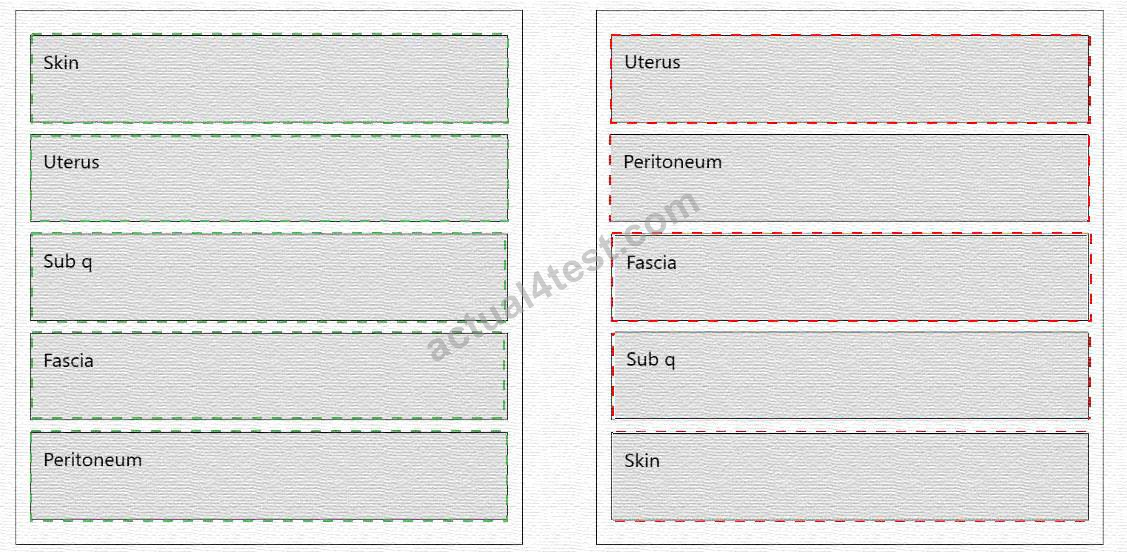
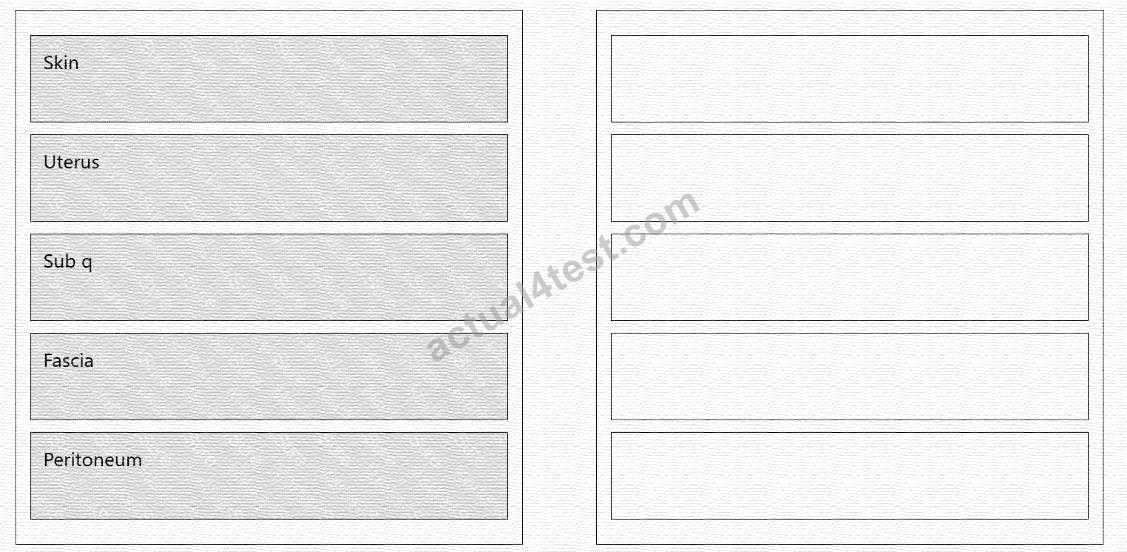
                                                                                                                  Place the following structures in the correct order of tissue closure for a cesarean section performed through a Pfannenstiel incision, proceeding from the innermost layer to the outermost layer of the abdominal cavity.
                                                                                                                  Available options: Uterus, Skin, Subcutaneous Tissue (Sub-Q), Peritoneum, Fascia.
                                                                                                                  Reveal Solution  Discussion  0

                                                                                                                  Correct Answer:


                                                                                                                  Explanation:
                                                                                                                  1
                                                                                                                  Uterus
                                                                                                                  2
                                                                                                                  Peritoneum
                                                                                                                  3
                                                                                                                  Fascia
                                                                                                                  4
                                                                                                                  Subcutaneous Tissue (Sub-Q)
                                                                                                                  5
                                                                                                                  Skin
                                                                                                                  During a cesarean section performed through a Pfannenstiel incision, surgical closure proceeds from the deepest operative structures toward the superficial abdominal wall. Understanding this anatomical sequence is essential for anticipating surgical instruments, suture materials, and tissue-handling requirements.
                                                                                                                  First, the uterus is repaired following delivery of the infant and placenta. The uterine incision is typically closed using absorbable sutures, with single-layer or double-layer closure selected according to clinical circumstances. Adequate hemostasis is essential to prevent postpartum hemorrhage.
                                                                                                                  Second, the peritoneum is the next anatomical layer in the examination sequence. When peritoneal closure is performed, it follows uterine repair. However, contemporary evidence-based guidelines recommend leaving the visceral and parietal peritoneum unsutured during routine cesarean delivery.
                                                                                                                  NICE+1
                                                                                                                  Third, the fascia is reapproximated using appropriate absorbable sutures. Fascial closure restores abdominal wall integrity and helps prevent wound dehiscence and incisional herniation.
                                                                                                                  Fourth, the subcutaneous tissue may be approximated to reduce dead space, particularly when subcutaneous fat thickness exceeds approximately 2 cm.
                                                                                                                  Finally, the skin is closed using an appropriate technique, commonly subcuticular sutures.
                                                                                                                  This inside-to-outside progression supports proper wound approximation, hemostasis, and postoperative wound integrity.
                                                                                                                  References:
                                                                                                                  NCCT TS-C Detailed Test Plan - Intraoperative Care and Preparation; Surgical Anatomy; Closure Assistance.
                                                                                                                  NICE NG192 - Caesarean Birth: Surgical Techniques and Closure .

                                                                                                                  Question #3

                                                                                                                  Which of the following factors has the GREATEST influence on patient temperature change during surgery?

                                                                                                                  • A. Monitored anesthesia care (MAC)
                                                                                                                  • B. Length of surgery
                                                                                                                  • C. State of hemostasis
                                                                                                                  • D. Position of patient
                                                                                                                  Reveal Solution  Discussion  0

                                                                                                                  Correct Answer: B  🗳️

                                                                                                                  Explanation: Only visible for Actual4test members. You can sign-up / login (it's free).

                                                                                                                  Question #4

                                                                                                                  Which of the following are purposes of pressure dressings? (Select the three correct answers.)

                                                                                                                  • A. To prevent dehiscence of an abdominal wound
                                                                                                                  • B. To reduce the formation of hematomas
                                                                                                                  • C. To eliminate dead space
                                                                                                                  • D. To seal a colostomy bag
                                                                                                                  • E. To dress a wound around a drain
                                                                                                                  Reveal Solution  Discussion  0

                                                                                                                  Correct Answer: A,B,C  🗳️

                                                                                                                  Explanation: Only visible for Actual4test members. You can sign-up / login (it's free).

                                                                                                                  Question #5

                                                                                                                  What fluid is used to assist in cast and splint hardening?

                                                                                                                  • A. Ice water
                                                                                                                  • B. Lukewarm water
                                                                                                                  • C. Lukewarm saline
                                                                                                                  • D. Hot water
                                                                                                                  Reveal Solution  Discussion  0

                                                                                                                  Correct Answer: B  🗳️

                                                                                                                  Explanation: Only visible for Actual4test members. You can sign-up / login (it's free).

                                                                                                                  Viewing page 1 out of 36 pages.
                                                                                                                  Viewing questions 1-5 out of 177 questions.

                                                                                                                  3%

                                                                                                                  Contact US:

                                                                                                                  Support: Contact now 

                                                                                                                  Go To TS-C Questions

                                                                                                                  Related Certifications

                                                                                                                  Over 677509+ Satisfied Customers

                                                                                                                  0 Customer ReviewsCustomers Feedback (* Some similar or old comments have been hidden.)

                                                                                                                  LEAVE A REPLY

                                                                                                                  Your email address will not be published. Required fields are marked *

                                                                                                                  QUALITY AND VALUE

                                                                                                                  Actual4test Practice Exams are written to the highest standards of technical accuracy, using only certified subject matter experts and published authors for development - no all study materials.

                                                                                                                  Tested and Approved

                                                                                                                  We are committed to the process of vendor and third party approvals. We believe professionals and executives alike deserve the confidence of quality coverage these authorizations provide.

                                                                                                                  Easy to Pass

                                                                                                                  If you prepare for the exams using our Actual4test testing engine, It is easy to succeed for all certifications in the first attempt. You don't have to deal with all dumps or any free torrent / rapidshare all stuff.

                                                                                                                  Try Before Buy

                                                                                                                  Actual4test offers free demo of each product. You can check out the interface, question quality and usability of our practice exams before you decide to buy.

                                                                                                                  Our Clients