


2024 Databricks-Machine-Learning-Associate Premium Files Test pdf - Free Dumps Collection
Get ready to pass the Databricks-Machine-Learning-Associate Exam right now using our ML Data Scientist Exam Package
Databricks Databricks-Machine-Learning-Associate Exam Syllabus Topics:
| Topic | Details |
|---|---|
| Topic 1 |
|
| Topic 2 |
|
| Topic 3 |
|
| Topic 4 |
|
NEW QUESTION # 44
A data scientist wants to use Spark ML to one-hot encode the categorical features in their PySpark DataFrame features_df. A list of the names of the string columns is assigned to the input_columns variable.
They have developed this code block to accomplish this task: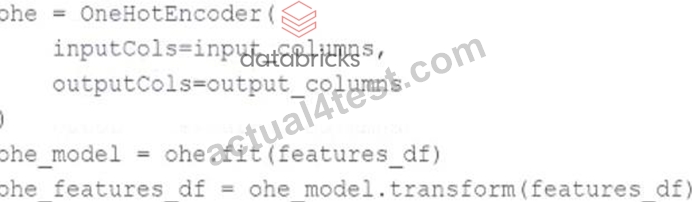
The code block is returning an error.
Which of the following adjustments does the data scientist need to make to accomplish this task?
- A. They need to specify the method parameter to the OneHotEncoder.
- B. They need to use VectorAssembler prior to one-hot encoding the features.
- C. They need to remove the line with the fit operation.
- D. They need to use Stringlndexer prior to one-hot encodinq the features.
Answer: D
Explanation:
The OneHotEncoder in Spark ML requires numerical indices as inputs rather than string labels. Therefore, you need to first convert the string columns to numerical indices using StringIndexer. After that, you can apply OneHotEncoder to these indices.
Corrected code:
from pyspark.ml.feature import StringIndexer, OneHotEncoder # Convert string column to index indexers = [StringIndexer(inputCol=col, outputCol=col+"_index") for col in input_columns] indexer_model = Pipeline(stages=indexers).fit(features_df) indexed_features_df = indexer_model.transform(features_df) # One-hot encode the indexed columns ohe = OneHotEncoder(inputCols=[col+"_index" for col in input_columns], outputCols=output_columns) ohe_model = ohe.fit(indexed_features_df) ohe_features_df = ohe_model.transform(indexed_features_df) Reference:
PySpark ML Documentation
NEW QUESTION # 45
A machine learning engineer has identified the best run from an MLflow Experiment. They have stored the run ID in the run_id variable and identified the logged model name as "model". They now want to register that model in the MLflow Model Registry with the name "best_model".
Which lines of code can they use to register the model associated with run_id to the MLflow Model Registry?
- A. millow.register_model(f"runs:/{run_id)/model")
- B. mlflow.register_model(run_id, "best_model")
- C. mlflow.register_model(f"runs:/{run_id}/best_model", "model")
- D. mlflow.register_model(f"runs:/{run_id}/model", "best_model")
Answer: D
Explanation:
To register a model that has been identified by a specific run_id in the MLflow Model Registry, the appropriate line of code is:
mlflow.register_model(f"runs:/{run_id}/model", "best_model")
This code correctly specifies the path to the model within the run (runs:/{run_id}/model) and registers it under the name "best_model" in the Model Registry. This allows the model to be tracked, managed, and transitioned through different stages (e.g., Staging, Production) within the MLflow ecosystem.
Reference
MLflow documentation on model registry: https://www.mlflow.org/docs/latest/model-registry.html#registering-a-model
NEW QUESTION # 46
Which of the following tools can be used to distribute large-scale feature engineering without the use of a UDF or pandas Function API for machine learning pipelines?
- A. Scikit-learn
- B. PyTorch
- C. Spark ML
- D. Keras
Answer: C
Explanation:
Spark MLlib is a machine learning library within Apache Spark that provides scalable and distributed machine learning algorithms. It is designed to work with Spark DataFrames and leverages Spark's distributed computing capabilities to perform large-scale feature engineering and model training without the need for user-defined functions (UDFs) or the pandas Function API. Spark MLlib provides built-in transformations and algorithms that can be applied directly to large datasets.
Reference:
Databricks documentation on Spark MLlib: Spark MLlib
NEW QUESTION # 47
A data scientist has developed a machine learning pipeline with a static input data set using Spark ML, but the pipeline is taking too long to process. They increase the number of workers in the cluster to get the pipeline to run more efficiently. They notice that the number of rows in the training set after reconfiguring the cluster is different from the number of rows in the training set prior to reconfiguring the cluster.
Which of the following approaches will guarantee a reproducible training and test set for each model?
- A. Set a speed in the data splitting operation
- B. Write out the split data sets to persistent storage
- C. Manually configure the cluster
- D. Manually partition the input data
Answer: B
Explanation:
To ensure reproducible training and test sets, writing the split data sets to persistent storage is a reliable approach. This allows you to consistently load the same training and test data for each model run, regardless of cluster reconfiguration or other changes in the environment.
Correct approach:
Split the data.
Write the split data to persistent storage (e.g., HDFS, S3).
Load the data from storage for each model training session.
train_df, test_df = spark_df.randomSplit([0.8, 0.2], seed=42) train_df.write.parquet("path/to/train_df.parquet") test_df.write.parquet("path/to/test_df.parquet") # Later, load the data train_df = spark.read.parquet("path/to/train_df.parquet") test_df = spark.read.parquet("path/to/test_df.parquet") Reference:
Spark DataFrameWriter Documentation
NEW QUESTION # 48
Which of the following evaluation metrics is not suitable to evaluate runs in AutoML experiments for regression problems?
- A. F1
- B. MAE
- C. R-squared
- D. MSE
Answer: A
Explanation:
The code block provided by the machine learning engineer will perform the desired inference when the Feature Store feature set was logged with the model at model_uri. This ensures that all necessary feature transformations and metadata are available for the model to make predictions. The Feature Store in Databricks allows for seamless integration of features and models, ensuring that the required features are correctly used during inference.
Reference:
Databricks documentation on Feature Store: Feature Store in Databricks
NEW QUESTION # 49
A data scientist has defined a Pandas UDF function predict to parallelize the inference process for a single-node model: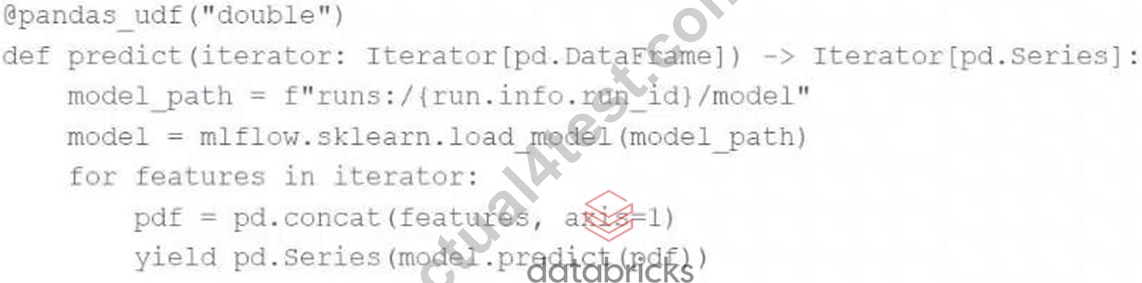
They have written the following incomplete code block to use predict to score each record of Spark DataFrame spark_df: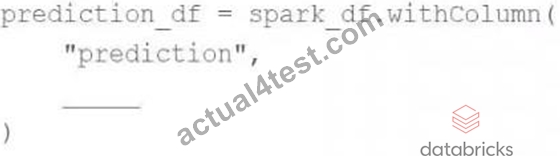
Which of the following lines of code can be used to complete the code block to successfully complete the task?
- A. predict(spark_df.columns)
- B. predict(Iterator(spark_df))
- C. mapInPandas(predict)
- D. mapInPandas(predict(spark_df.columns))
- E. predict(*spark_df.columns)
Answer: C
Explanation:
To apply the Pandas UDF predict to each record of a Spark DataFrame, you use the mapInPandas method. This method allows the Pandas UDF to operate on partitions of the DataFrame as pandas DataFrames, applying the specified function (predict in this case) to each partition. The correct code completion to execute this is simply mapInPandas(predict), which specifies the UDF to use without additional arguments or incorrect function calls.
Reference:
PySpark DataFrame documentation (Using mapInPandas with UDFs).
NEW QUESTION # 50
A data scientist uses 3-fold cross-validation when optimizing model hyperparameters for a regression problem. The following root-mean-squared-error values are calculated on each of the validation folds:
* 10.0
* 12.0
* 17.0
Which of the following values represents the overall cross-validation root-mean-squared error?
- A. 10.0
- B. 17.0
- C. 12.0
- D. 13.0
- E. 39.0
Answer: D
Explanation:
To calculate the overall cross-validation root-mean-squared error (RMSE), you average the RMSE values obtained from each validation fold. Given the RMSE values of 10.0, 12.0, and 17.0 for the three folds, the overall cross-validation RMSE is calculated as the average of these three values:
Overall CV RMSE=10.0+12.0+17.03=39.03=13.0Overall CV RMSE=310.0+12.0+17.0=339.0=13.0 Thus, the correct answer is 13.0, which accurately represents the average RMSE across all folds.
Reference:
Cross-validation in Regression (Understanding Cross-Validation Metrics).
NEW QUESTION # 51
A data scientist wants to parallelize the training of trees in a gradient boosted tree to speed up the training process. A colleague suggests that parallelizing a boosted tree algorithm can be difficult.
Which of the following describes why?
- A. Gradient boosting requires access to all data at once which cannot happen during parallelization.
- B. Gradient boosting is an iterative algorithm that requires information from the previous iteration to perform the next step.
- C. Gradient boosting calculates gradients in evaluation metrics using all cores which prevents parallelization.
- D. Gradient boosting is not a linear algebra-based algorithm which is required for parallelization
Answer: B
Explanation:
Gradient boosting is fundamentally an iterative algorithm where each new tree is built based on the errors of the previous ones. This sequential dependency makes it difficult to parallelize the training of trees in gradient boosting, as each step relies on the results from the preceding step. Parallelization in this context would undermine the core methodology of the algorithm, which depends on sequentially improving the model's performance with each iteration.
Reference:
Machine Learning Algorithms (Challenges with Parallelizing Gradient Boosting).
Gradient boosting is an ensemble learning technique that builds models in a sequential manner. Each new model corrects the errors made by the previous ones. This sequential dependency means that each iteration requires the results of the previous iteration to make corrections. Here is a step-by-step explanation of why this makes parallelization challenging:
Sequential Nature: Gradient boosting builds one tree at a time. Each tree is trained to correct the residual errors of the previous trees. This requires the model to complete one iteration before starting the next.
Dependence on Previous Iterations: The gradient calculation at each step depends on the predictions made by the previous models. Therefore, the model must wait until the previous tree has been fully trained and evaluated before starting to train the next tree.
Difficulty in Parallelization: Because of this dependency, it is challenging to parallelize the training process. Unlike algorithms that process data independently in each step (e.g., random forests), gradient boosting cannot easily distribute the work across multiple processors or cores for simultaneous execution.
This iterative and dependent nature of the gradient boosting process makes it difficult to parallelize effectively.
Reference
Gradient Boosting Machine Learning Algorithm
Understanding Gradient Boosting Machines
NEW QUESTION # 52
A data scientist is using Spark SQL to import their data into a machine learning pipeline. Once the data is imported, the data scientist performs machine learning tasks using Spark ML.
Which of the following compute tools is best suited for this use case?
- A. None of these compute tools support this task
- B. SQL Warehouse
- C. Single Node cluster
- D. Standard cluster
Answer: D
Explanation:
For a data scientist using Spark SQL to import data and then performing machine learning tasks using Spark ML, the best-suited compute tool is a Standard cluster. A Standard cluster in Databricks provides the necessary resources and scalability to handle large datasets and perform distributed computing tasks efficiently, making it ideal for running Spark SQL and Spark ML operations.
Reference:
Databricks documentation on clusters: Clusters in Databricks
NEW QUESTION # 53
Which of the following machine learning algorithms typically uses bagging?
- A. Linear regression
- B. K-means
- C. Gradient boosted trees
- D. Random forest
- E. Decision tree
Answer: D
Explanation:
Random Forest is a machine learning algorithm that typically uses bagging (Bootstrap Aggregating). Bagging involves training multiple models independently on different random subsets of the data and then combining their predictions. Random Forests consist of many decision trees trained on random subsets of the training data and features, and their predictions are averaged to improve accuracy and control overfitting. This method enhances model robustness and predictive performance.
Reference:
Ensemble Methods in Machine Learning (Understanding Bagging and Random Forests).
NEW QUESTION # 54
A data scientist has developed a linear regression model using Spark ML and computed the predictions in a Spark DataFrame preds_df with the following schema:
prediction DOUBLE
actual DOUBLE
Which of the following code blocks can be used to compute the root mean-squared-error of the model according to the data in preds_df and assign it to the rmse variable?
- A.
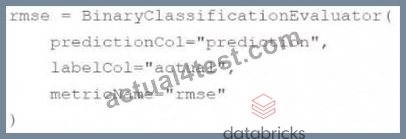
- B.

- C.
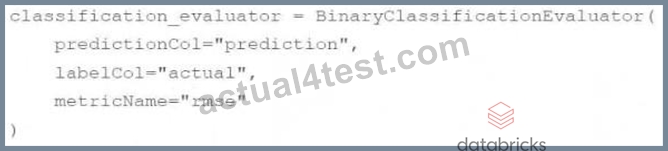
- D.
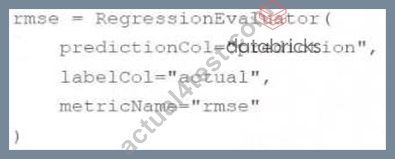
Answer: D
Explanation:
The code block to compute the root mean-squared error (RMSE) for a linear regression model in Spark ML should use the RegressionEvaluator class with metricName set to "rmse". Given the schema of preds_df with columns prediction and actual, the correct evaluator setup will specify predictionCol="prediction" and labelCol="actual". Thus, the appropriate code block (Option C in your list) that uses RegressionEvaluator to compute the RMSE is the correct choice. This setup correctly measures the performance of the regression model using the predictions and actual outcomes from the DataFrame.
Reference:
Spark ML documentation (Using RegressionEvaluator to Compute RMSE).
NEW QUESTION # 55
A machine learning engineer would like to develop a linear regression model with Spark ML to predict the price of a hotel room. They are using the Spark DataFrame train_df to train the model.
The Spark DataFrame train_df has the following schema:
The machine learning engineer shares the following code block:
Which of the following changes does the machine learning engineer need to make to complete the task?
- A. They need to call the transform method on train df
- B. They need to convert the features column to be a vector
- C. They need to utilize a Pipeline to fit the model
- D. They need to split the features column out into one column for each feature
- E. They do not need to make any changes
Answer: B
Explanation:
In Spark ML, the linear regression model expects the feature column to be a vector type. However, if the features column in the DataFrame train_df is not already in this format (such as being a column of type UDT or a non-vectorized type), the engineer needs to convert it to a vector column using a transformer like VectorAssembler. This is a critical step in preparing the data for modeling as Spark ML models require input features to be combined into a single vector column.
Reference
Spark MLlib documentation for LinearRegression: https://spark.apache.org/docs/latest/ml-classification-regression.html#linear-regression
NEW QUESTION # 56
A data scientist is wanting to explore summary statistics for Spark DataFrame spark_df. The data scientist wants to see the count, mean, standard deviation, minimum, maximum, and interquartile range (IQR) for each numerical feature.
Which of the following lines of code can the data scientist run to accomplish the task?
- A. spark_df.printSchema()
- B. spark_df.stats()
- C. spark_df.summary ()
- D. spark_df.toPandas()
- E. spark_df.describe().head()
Answer: C
Explanation:
The summary() function in PySpark's DataFrame API provides descriptive statistics which include count, mean, standard deviation, min, max, and quantiles for numeric columns. Here are the steps on how it can be used:
Import PySpark: Ensure PySpark is installed and correctly configured in the Databricks environment.
Load Data: Load the data into a Spark DataFrame.
Apply Summary: Use spark_df.summary() to generate summary statistics.
View Results: The output from the summary() function includes the statistics specified in the query (count, mean, standard deviation, min, max, and potentially quartiles which approximate the interquartile range).
Reference
PySpark Documentation: https://spark.apache.org/docs/latest/api/python/reference/api/pyspark.sql.DataFrame.summary.html
NEW QUESTION # 57
A data scientist wants to tune a set of hyperparameters for a machine learning model. They have wrapped a Spark ML model in the objective function objective_function and they have defined the search space search_space.
As a result, they have the following code block: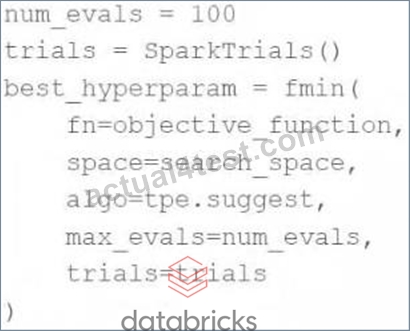
Which of the following changes do they need to make to the above code block in order to accomplish the task?
- A. Change SparkTrials() to Trials()
- B. Remove the trials=trials argument
- C. Change fmin() to fmax()
- D. Reduce num_evals to be less than 10
- E. Remove the algo=tpe.suggest argument
Answer: A
Explanation:
The SparkTrials() is used to distribute trials of hyperparameter tuning across a Spark cluster. If the environment does not support Spark or if the user prefers not to use distributed computing for this purpose, switching to Trials() would be appropriate. Trials() is the standard class for managing search trials in Hyperopt but does not distribute the computation. If the user is encountering issues with SparkTrials() possibly due to an unsupported configuration or an error in the cluster setup, using Trials() can be a suitable change for running the optimization locally or in a non-distributed manner.
Reference
Hyperopt documentation: http://hyperopt.github.io/hyperopt/
NEW QUESTION # 58
In which of the following situations is it preferable to impute missing feature values with their median value over the mean value?
- A. When the features are of the categorical type
- B. When the features contain no outliers
- C. When the features contain a lot of extreme outliers
- D. When the features are of the boolean type
- E. When the features contain no missing no values
Answer: C
Explanation:
Imputing missing values with the median is often preferred over the mean in scenarios where the data contains a lot of extreme outliers. The median is a more robust measure of central tendency in such cases, as it is not as heavily influenced by outliers as the mean. Using the median ensures that the imputed values are more representative of the typical data point, thus preserving the integrity of the dataset's distribution. The other options are not specifically relevant to the question of handling outliers in numerical data.
Reference:
Data Imputation Techniques (Dealing with Outliers).
NEW QUESTION # 59
A machine learning engineer is trying to perform batch model inference. They want to get predictions using the linear regression model saved at the path model_uri for the DataFrame batch_df.
batch_df has the following schema:
customer_id STRING
The machine learning engineer runs the following code block to perform inference on batch_df using the linear regression model at model_uri: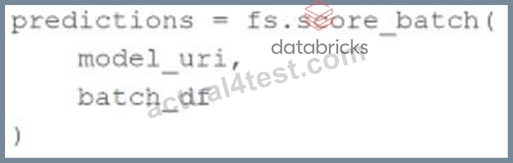
In which situation will the machine learning engineer's code block perform the desired inference?
- A. This code block will not perform the desired inference in any situation.
- B. When the model at model_uri only uses customer_id as a feature
- C. When all of the features used by the model at model_uri are in a Spark DataFrame in the PySpark
- D. When the Feature Store feature set was logged with the model at model_uri
- E. When all of the features used by the model at model_uri are in a single Feature Store table
Answer: D
Explanation:
The code block provided by the machine learning engineer will perform the desired inference when the Feature Store feature set was logged with the model at model_uri. This ensures that all necessary feature transformations and metadata are available for the model to make predictions. The Feature Store in Databricks allows for seamless integration of features and models, ensuring that the required features are correctly used during inference.
Reference:
Databricks documentation on Feature Store: Feature Store in Databricks
NEW QUESTION # 60
An organization is developing a feature repository and is electing to one-hot encode all categorical feature variables. A data scientist suggests that the categorical feature variables should not be one-hot encoded within the feature repository.
Which of the following explanations justifies this suggestion?
- A. One-hot encoding is computationally intensive and should only be performed on small samples of training sets for individual machine learning problems.
- B. One-hot encoding is a potentially problematic categorical variable strategy for some machine learning algorithms.
- C. One-hot encoding is not a common strategy for representing categorical feature variables numerically.
- D. One-hot encoding is not supported by most machine learning libraries.
- E. One-hot encoding is dependent on the target variable's values which differ for each application.
Answer: B
Explanation:
One-hot encoding transforms categorical variables into a format that can be provided to machine learning algorithms to better predict the output. However, when done prematurely or universally within a feature repository, it can be problematic:
Dimensionality Increase: One-hot encoding significantly increases the feature space, especially with high cardinality features, which can lead to high memory consumption and slower computation.
Model Specificity: Some models handle categorical variables natively (like decision trees and boosting algorithms), and premature one-hot encoding can lead to inefficiency and loss of information (e.g., ordinal relationships).
Sparse Matrix Issue: It often results in a sparse matrix where most values are zero, which can be inefficient in both storage and computation for some algorithms.
Generalization vs. Specificity: Encoding should ideally be tailored to specific models and use cases rather than applied generally in a feature repository.
Reference
"Feature Engineering and Selection: A Practical Approach for Predictive Models" by Max Kuhn and Kjell Johnson (CRC Press, 2019).
NEW QUESTION # 61
A data scientist is wanting to explore the Spark DataFrame spark_df. The data scientist wants visual histograms displaying the distribution of numeric features to be included in the exploration.
Which of the following lines of code can the data scientist run to accomplish the task?
- A. dbutils.data.summarize (spark_df)
- B. spark_df.summary()
- C. dbutils.data(spark_df).summarize()
- D. This task cannot be accomplished in a single line of code.
- E. spark_df.describe()
Answer: A
Explanation:
To display visual histograms and summaries of the numeric features in a Spark DataFrame, the Databricks utility function dbutils.data.summarize can be used. This function provides a comprehensive summary, including visual histograms.
Correct code:
dbutils.data.summarize(spark_df)
Other options like spark_df.describe() and spark_df.summary() provide textual statistical summaries but do not include visual histograms.
Reference:
Databricks Utilities Documentation
NEW QUESTION # 62
A data scientist is developing a single-node machine learning model. They have a large number of model configurations to test as a part of their experiment. As a result, the model tuning process takes too long to complete. Which of the following approaches can be used to speed up the model tuning process?
- A. Implement MLflow Experiment Tracking
- B. Enable autoscaling clusters
- C. Scale up with Spark ML
- D. Parallelize with Hyperopt
Answer: D
Explanation:
To speed up the model tuning process when dealing with a large number of model configurations, parallelizing the hyperparameter search using Hyperopt is an effective approach. Hyperopt provides tools like SparkTrials which can run hyperparameter optimization in parallel across a Spark cluster.
Example:
from hyperopt import fmin, tpe, hp, SparkTrials search_space = { 'x': hp.uniform('x', 0, 1), 'y': hp.uniform('y', 0, 1) } def objective(params): return params['x'] ** 2 + params['y'] ** 2 spark_trials = SparkTrials(parallelism=4) best = fmin(fn=objective, space=search_space, algo=tpe.suggest, max_evals=100, trials=spark_trials) Reference:
Hyperopt Documentation
NEW QUESTION # 63
Which of the following describes the relationship between native Spark DataFrames and pandas API on Spark DataFrames?
- A. pandas API on Spark DataFrames are made up of Spark DataFrames and additional metadata
- B. pandas API on Spark DataFrames are single-node versions of Spark DataFrames with additional metadata
- C. pandas API on Spark DataFrames are less mutable versions of Spark DataFrames
- D. pandas API on Spark DataFrames are more performant than Spark DataFrames
Answer: A
Explanation:
The pandas API on Spark DataFrames are made up of Spark DataFrames with additional metadata. The pandas API on Spark aims to provide the pandas-like experience with the scalability and distributed nature of Spark. It allows users to work with pandas functions on large datasets by leveraging Spark's underlying capabilities.
Reference:
Databricks documentation on pandas API on Spark: pandas API on Spark
NEW QUESTION # 64
A data scientist is using MLflow to track their machine learning experiment. As a part of each of their MLflow runs, they are performing hyperparameter tuning. The data scientist would like to have one parent run for the tuning process with a child run for each unique combination of hyperparameter values. All parent and child runs are being manually started with mlflow.start_run.
Which of the following approaches can the data scientist use to accomplish this MLflow run organization?
- A. They can start each child run with the same experiment ID as the parent run
- B. They can start each child run inside the parent run's indented code block using mlflow.start runO
- C. They can turn on Databricks Autologging
- D. They can specify nested=True when starting the child run for each unique combination of hyperparameter values
- E. They can specify nested=True when starting the parent run for the tuning process
Answer: D
Explanation:
To organize MLflow runs with one parent run for the tuning process and a child run for each unique combination of hyperparameter values, the data scientist can specify nested=True when starting the child run. This approach ensures that each child run is properly nested under the parent run, maintaining a clear hierarchical structure for the experiment. This nesting helps in tracking and comparing different hyperparameter combinations within the same tuning process.
Reference:
MLflow Documentation (Managing Nested Runs).
NEW QUESTION # 65
A data scientist has created two linear regression models. The first model uses price as a label variable and the second model uses log(price) as a label variable. When evaluating the RMSE of each model by comparing the label predictions to the actual price values, the data scientist notices that the RMSE for the second model is much larger than the RMSE of the first model.
Which of the following possible explanations for this difference is invalid?
- A. The data scientist failed to take the log of the predictions in the first model prior to computing the RMSE
- B. The RMSE is an invalid evaluation metric for regression problems
- C. The data scientist failed to exponentiate the predictions in the second model prior to computing the RMSE
- D. The first model is much more accurate than the second model
- E. The second model is much more accurate than the first model
Answer: B
Explanation:
The Root Mean Squared Error (RMSE) is a standard and widely used metric for evaluating the accuracy of regression models. The statement that it is invalid is incorrect. Here's a breakdown of why the other statements are or are not valid:
Transformations and RMSE Calculation: If the model predictions were transformed (e.g., using log), they should be converted back to their original scale before calculating RMSE to ensure accuracy in the evaluation. Missteps in this conversion process can lead to misleading RMSE values.
Accuracy of Models: Without additional information, we can't definitively say which model is more accurate without considering their RMSE values properly scaled back to the original price scale.
Appropriateness of RMSE: RMSE is entirely valid for regression problems as it provides a measure of how accurately a model predicts the outcome, expressed in the same units as the dependent variable.
Reference
"Applied Predictive Modeling" by Max Kuhn and Kjell Johnson (Springer, 2013), particularly the chapters discussing model evaluation metrics.
NEW QUESTION # 66
Which of the following is a benefit of using vectorized pandas UDFs instead of standard PySpark UDFs?
- A. The vectorized pandas UDFs work on distributed DataFrames
- B. The vectorized pandas UDFs allow for the use of type hints
- C. The vectorized pandas UDFs allow for pandas API use inside of the function
- D. The vectorized pandas UDFs process data in memory rather than spilling to disk
- E. The vectorized pandas UDFs process data in batches rather than one row at a time
Answer: E
Explanation:
Vectorized pandas UDFs, also known as Pandas UDFs, are a powerful feature in PySpark that allows for more efficient operations than standard UDFs. They operate by processing data in batches, utilizing vectorized operations that leverage pandas to perform operations on whole batches of data at once. This approach is much more efficient than processing data row by row as is typical with standard PySpark UDFs, which can significantly speed up the computation.
Reference
PySpark Documentation on UDFs: https://spark.apache.org/docs/latest/api/python/user_guide/sql/arrow_pandas.html#pandas-udfs-a-k-a-vectorized-udfs
NEW QUESTION # 67
......
Master 2024 Latest The Questions ML Data Scientist and Pass Databricks-Machine-Learning-Associate Real Exam!: https://www.actual4test.com/Databricks-Machine-Learning-Associate_examcollection.html
A fully updated 2024 Databricks-Machine-Learning-Associate Exam Dumps exam guide from training expert Actual4test: https://drive.google.com/open?id=1c3wCJAabJBP06s1zl8eQjKdzyipkuNMW