


Check Real Salesforce Salesforce-MuleSoft-Developer-I Exam Question for Free (2025)
Get Ready to Boost your Prepare for your Salesforce-MuleSoft-Developer-I Exam with 237 Questions
NEW QUESTION # 122
Which of the module is imported automatically in Dataweave scripts?
- A. dw::core
- B. dw::Runtime
- C. dw::System
- D. dw::Crypto
Answer: A
Explanation:
Core (dw::Core) This module contains core DataWeave functions for data transformations. It is automatically imported into any DataWeave script.
NEW QUESTION # 123
According to Mulesoft, how are Modern APIs treated as?
- A. SOAP API's
- B. Products
- C. Rest API's
- D. Code
Answer: B
Explanation:
Correct answer is Products
Modern API has three features 1) Treated as products for easy consumption 2) Discoverable and accessible through self-service 3) Easily managed for security , scalability and performance
NEW QUESTION # 124
How does APIkit determine the number of flows to generate from a RAML specification?
- A. Creates a separate flow for each resource that contains child resources
- B. Creates a separate flow for each resource
- C. Creates a separate flow for each HTTP method
- D. Creates a separate flow for each response status code
Answer: C
Explanation:
APIKIt Creates a separate flow for each HTTP method
NEW QUESTION # 125
Refer to the exhibits.
All three of the conditions for the Choice router are true. What messages are written in the application log?
- A. Route1
- B. Route1,Route2,Default
- C. Route2
- D. Route1,Route2
Answer: A
Explanation:
Only one of the routes in the Choice router executes, meaning that the first expression that evaluates to true triggers that route1 execution and the others are not checked. If none of the expressions are true, then the default route executes. Hence only Route1 will be executed as it is the first expression. hence output of logger is Route1.
MuleSoft Doc Ref : https://docs.mulesoft.com/mule-runtime/4.3/choice-router-concept The Choice router dynamically routes messages through a flow according to a set of DataWeave expressions that evaluate message content. Each expression is associated with a different routing option. The effect is to add conditional processing to a flow, similar to an if/then/else code block in most programming languages.
Only one of the routes in the Choice router executes, meaning that the first expression that evaluates to true triggers that route's execution and the others are not checked. If none of the expressions are true, then the default route executes.
NEW QUESTION # 126
How are multiple conditions used in a Choice router to route events?
- A. To find the FIRST true condition, then distribute the event to the ONE matched route.
- B. To route the same event to the matched route of EVERY true condition
- C. To find the FIRST true condition, then route the same event to the matched route and ALL FOLLOWING routes
- D. None of these
Answer: A
Explanation:
Choice router finds the FIRST true condition, then distribute the event to the ONE matched route.
MuleSoft Doc Ref : https://docs.mulesoft.com/mule-runtime/4.1/choice-router-concept The Choice router dynamically routes messages through a flow according to a set of DataWeave expressions that evaluate message content. Each expression is associated with a different routing option. The effect is to add conditional processing to a flow, similar to an if/then/else code block in most programming languages.
Only one of the routes in the Choice router executes, meaning that the first expression that evaluates to true triggers that route's execution and the others are not checked. If none of the expressions are true, then the default route executes.
NEW QUESTION # 127
Which Mule component provides a real-time, graphical representation of the APIs and mule applications that are running and discoverable?
- A. Runtime Manager
- B. API Manager
- C. Anypoint Visualizer
- D. API Notebook
Answer: C
Explanation:
Correct answer is Anypoint Visualizer
MuleSoft Doc Ref : https://docs.mulesoft.com/visualizer/
Anypoint Visualizer provides a real-time, graphical representation of the APIs, and Mule applications that are running and discoverable. It also displays third-party systems that are invoked by a Mule API, proxy, or application within your application network. The data displayed in the graph is dynamically updated and does not require prior configuration. Additionally, the data displayed is secure, as only users with the proper permissions can view the application network graph.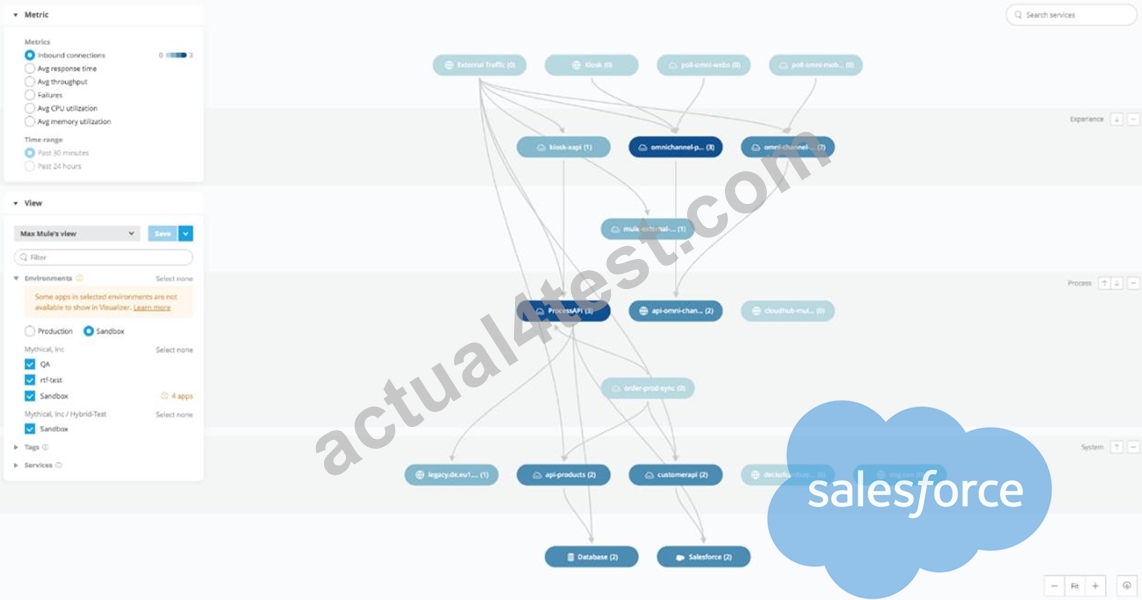
NEW QUESTION # 128
Which out of below is not an asset?
- A. Example
- B. Exchange
- C. Connector
- D. Template
Answer: B
Explanation:
Exchange is the odd man out here. Rest all are type of asset
NEW QUESTION # 129
Which of the below is not the mandatory configurations for HTTP Listener?
- A. Allowed methods
- B. HTTP port in Connector Configuration
- C. Path
- D. HTTP host in Connector Configuration
Answer: A
Explanation:
Allowed methods is an optional configuration. If nothing is specified then all HTTP methods are supported.
Rest all are mandatory.
NEW QUESTION # 130
An app team is developing a mobile banking app. It took them two months to create their own APIs to access transaction information from a central database. The app team later found out that another team had already built an API that accesses the transaction information they need.
According to MuleSoft, what organization structure could have saved the app team two months of development time?
- A. Center of Excellence
- B. Central API Review Board
- C. Center for Enablement
- D. MuleSoft Support Center
Answer: C
Explanation:
Reference:
Center for Enablement is correct answer .It is a cross-functional team typically staffed with members from central IT, line-of-business departments, and digital innovation teams charged with productizing, publishing, and harvesting reusable assets and best practices. In this case , app team would have checked first with Center for Enablement before developing their own API's. Hence could have avoided re-work
NEW QUESTION # 131
Which of the below is not a valid category for connector type?
- A. Premium
- B. Select
- C. Community
- D. Gold
Answer: D
Explanation:
Gold is not valid category for connector types.
MuleSoft Doc Ref : https://docs.mulesoft.com/mule-runtime/3.7/anypoint-connectors#connector-support-categories
NEW QUESTION # 132
A shopping API contains a method to look up store details by department.
To get the information for a particular store, web clients will submit requests with a query parameter named department and uri parameter named storeId What is valid RAML snippet that supports requests from a web client to get a data for a specific storeId and department name?
- A. 1. get:
2. uriParameter:
3. {storeId}:
4. queryParameter:
5. department: - B. 1. /department:
2. get:
3. uriParameter:
4. storeId: - C. 1. /{storeId}:
2. get:
3. queryParameter:
4. department: - D. 1. get:
2. queryParameter:
3. department:
4. uriParameter:
5. {storeId}:
Answer: C
Explanation:
Lets revise few concepts RAML which can help us to find the answer of this question.
URI Parameters
Lets have a look at below example.
/foos:
/{id}:
/name/{name}:
Here, the braces { } around property names define URI parameters. They represent placeholders in each URI and do not reference root-level RAML file properties as we saw above in the baseUri declaration. The added lines represent the resources /foos/{id} and /foos/name/{name}.
Query Parameters
Now we'll define a way to query the foos collection using query parameters. Note that query parameters are defined using the same syntax that we used above for data types:
/foos:
get:
description: List all Foos matching query criteria, if provided;
otherwise list all Foos
queryParameters:
name?: string
ownerName?: string
Based on the above information , below is the only option which defines storeid as uri parameter and department as query parameter.
/{storeId}:
get:
queryParameter:
department:
NEW QUESTION # 133
A mule project contains MySQL database dependency . The project is exported from Anypoint Studio so that it can be deployed to Cloudhub. What export options needs to be selected to create the smallest deployable archive that will successfully deploy to Cloudhub?
- A. Select only below option 1) Attach project sources
- B. Select only below option 2) Include project module and dependencies
- C. Select both the options 1) Attach project sources 2) Include project module and dependencies
- D. No need to select any of the below options 1) Attach project sources 2) Include project module and dependencies
Answer: B
Explanation:
You can choose Attach Project Sources to include metadata that Studio requires to reimport the deployable file as an open Mule project into your workspace. You must keep the Attach Project Sources option selected to be able to import the packaged JAR file back into a Studio workspace. But requirement here is to create smallest deployable archive that will successfully deploy to Cloudhub. Hence we can ignore this option.
We need to select Include project module and dependencies
As actual modules and external dependencies required to run the Mule application in a Mule runtime engine Hence correct answer is Select only below option 2) Include project module and dependencies MuleSoft Doc Ref : https://docs.mulesoft.com/studio/7.5/import-export-packages#exporting-a-studio-project-to-a-deployable-mule-application
NEW QUESTION # 134
Refer to the exhibits.

A web client sends a POST request to the HTTP Listener with the payload "Hello-". What response is returned to the web client?
What response is returned to the web client?
- A. Hello- HTTP-] MS2-Three
- B. Hello-HTTP-Three
- C. Helb-JMS1-HTTP-JMS2 -Three
- D. HTTP-JMS2-Three
Answer: A
NEW QUESTION # 135
Refer to the exhibits.

A web client sends a POST request with the payload {"oid": "1000", "itemid": "AC200", "qty": "4" } to the Mule application. The File Write operation throws a FILE:CONNECTIVITY error.
What response message is returned to the web client?
- A. ''FILE:CONNECnvnY'
- B. "OTHER ERROR"
- C. "File written"
- D. "ORDER:NOT_CREATED"
Answer: D
NEW QUESTION # 136
A web client submits a request to http://localhost:8081?flrstName=john. What is the correct DataWeave expression to access the firstName parameter?
- A. #[message.queryParams.hrstName]
- B. #[message.inboundProperties.'http.query.params'.firstName]
- C. #[attributes.'http.query.params'.firstName]
- D. #[attributes.queryParams.firstName]
Answer: D
NEW QUESTION # 137
What is the object type returned by the File List operation?
- A. Object of Mule event objects
- B. Object of String file names
- C. Array of Mule event objects
- D. Array of String file names
Answer: C
Explanation:
The List operation returns an array of messages in which: Each message holds the file's content in its payload. The file's attributes section carries the file's metadata (such as name, creation time, and size). The payload is empty if the element is a folder.
NEW QUESTION # 138
A company has defined two RAML fragments, Book Data Type and Book Example to be used in APIs.
What would be valid RAML to use these fragments ?

- A. 1. #%RAML 1.0
2. title: Books
3. Book: bookDataType.raml
4. /books:
5. post:
6. body:
7. application/json:
8. type: Book
9. examples:
10. input: bookExample.raml
11. responses:
12. 201:
13. body:
14. application/json:
15. example:
16. message: Book added - B. 1. #%RAML 1.0
2. title: Books
3. types:
4. Book: ABC/Examples/bookDataType.raml
5. /books:
6. post:
7. body:
8. application/json:
9. type: Book
10. examples:
11. input: ABC/Examples/bookExample.raml
12. responses:
13. 201:
14. body:
15. application/json:
16. example:
17. message: Book added - C. 1. #%RAML 1.0
2. title: Books
3. Book: !include bookDataType.raml
4. /books:
5. post:
6. body:
7. application/json:
8. type: Book
9. examples:
10. input: !include bookExample.raml
11. responses:
12. 201:
13. body:
14. application/json:
15. example:
16. message: Book added - D. 1. #%RAML 1.0
2. title: Books
3. Book: bookDataType.raml
4. /books:
5. post:
6. body:
7. application/json:
8. type: Book
9. examples:
10. input: bookExample.raml
11. responses:
12. 201:
13. body:
14. application/json:
15. example:
16. message: Book added
Answer: A
Explanation:
* RAML file contains lot of information that could be considered as "not API-describing". Sort of "economy-class" members.
Equally important, but not necessarily part of the main RAML file.
* Through !includes, RAML allows us to build file-distributed API definitions, which is not only useful to encourage code reuse but also improves readability.
* We can create RAML fragments with such code and then include them in main RAML project using !include like:
types:
Book: !include bookDataType.raml and
examples:
input: !include bookExample.raml
* Additionally for
---------------------------------------------------------------------------------------------------------------------------------------- Correct Answer: D
NEW QUESTION # 139
......
Use Free Salesforce-MuleSoft-Developer-I Exam Questions that Stimulates Actual EXAM : https://www.actual4test.com/Salesforce-MuleSoft-Developer-I_examcollection.html
Get 100% Real Salesforce-MuleSoft-Developer-I Free Online Practice Test: https://drive.google.com/open?id=1ANoIrMte1dXJynAR0rgun-Gsz0I2xl1u