


FC0-U61 Questions Pass on Your First Attempt Dumps for CompTIA IT Fundamentals Certified
FC0-U61 Practice Test Pdf Exam Material
CompTIA FC0-U61 (CompTIA IT Fundamentals+ Certification) Exam is a vendor-neutral certification exam that tests the foundational knowledge of IT professionals. CompTIA IT Fundamentals+ Certification Exam certification is designed for individuals who are new to the field of IT or want to enhance their knowledge of basic IT concepts. FC0-U61 exam covers a broad range of topics, including hardware, software, networking, and security.
CompTIA FC0-U61 certification exam is a globally recognized certification that validates the candidate's basic knowledge and understanding of IT concepts. CompTIA IT Fundamentals+ Certification Exam certification is ideal for individuals just entering the IT industry or those who want to improve their IT skills. Passing the exam provides individuals with a competitive edge in the job market and can lead to better job opportunities with higher salaries.
NEW QUESTION # 108
A company requires several reports that analyze related information from sales, inventory, marketing, and compensation data. Which of the following is the BEST place to store this data?
- A. Network share
- B. Database
- C. Word processor
- D. Flat file
Answer: B
Explanation:
Explanation/Reference:
NEW QUESTION # 109
Which of the following protocols is used to relay email from a user's mail server?
- A. FTP
- B. POP3
- C. SMTP
- D. IMAP
Answer: C
Explanation:
SMTP stands for Simple Mail Transfer Protocol, which is used to relay email from a user's mail server to another mail server or from a mail client to a user's mail server. IMAP stands for Internet Message Access Protocol, which is used to access and manage email messages on a mail server. FTP stands for File Transfer Protocol, which is used to transfer files between computers over a network. POP3 stands for Post Office Protocol version 3, which is used to download email messages from a mail server to a mail client. References: The Official CompTIA IT Fundamentals (ITF+) Student Guide (Exam FC0-U61), Chapter 5: Infrastructure Concepts1
NEW QUESTION # 110
Which of the following can a company use to protect its logo?
- A. Copyright
- B. Trademark
- C. patent
- D. Domain name
Answer: B
Explanation:
Explanation
A trademark is the best option for a company to protect its logo. A trademark is a name, symbol, logo, or slogan that identifies a product or service and distinguishes it from others in the market. A trademark grants the owner the exclusive right to use the mark and to prevent others from using confusingly similar marks. A trademark can be registered with the appropriate authority to obtain legal protection and enforcement. A trademark can last indefinitely as long as it is used and renewed periodically. A trademark can also be indicated by the symbols ™ or ®. A copyright is not suitable for protecting a logo, as it only protects original works of authorship, such as books, music, movies, or software. A domain name is not suitable for protecting a logo, as it only identifies a website or an email address on the internet. A domain name can be registered with a domain name registrar to obtain exclusive use of the name for a certain period of time. A domain name can also be trademarked if it meets the criteria for trademark protection. A patent is not suitable for protecting a logo, as it only protects inventions or processes that are new, useful, and non-obvious. References: The Official CompTIA IT Fundamentals (ITF+) Student Guide (Exam FC0-U61), Chapter 8: Software Development Concepts
NEW QUESTION # 111
A programmer is generating results by iterating rows that provide values needed for one calculation. Which of the following functions best accomplishes this task?
- A. Branching
- B. Sorting
- C. Pausing for input
- D. Looping
Answer: D
Explanation:
Explanation
Looping is a function that allows a programmer to repeat a block of code for a certain number of times or until a condition is met. This is useful for iterating rows that provide values needed for one calculation, as it can perform the same operation on each row without writing redundant code. Branching is a function that allows a programmer to execute different blocks of code depending on a condition, such as an if-else statement.
Pausing for input is a function that allows a programmer to stop the execution of the code and wait for the user to enter some data, such as using the input() function in Python. Sorting is a function that allows a programmer to arrange a collection of data in a certain order, such as ascending or descending. References: CompTIA IT Fundamentals (ITF+) Study Guide: Exam FC0-U61, Second Edition, Chapter 4: Software Development Concepts, page 139
NEW QUESTION # 112
Which of the following is an advantage of a fiat file?
- A. Portability
- B. Scalability
- C. Multiple concurrent users
- D. Variety of data
Answer: A
Explanation:
The advantage of a flat file is portability. Portability is the ability of a file or a system to be easily transferred or used on different platforms or devices. A flat file is a type of file that stores data in plain text format with fixed fields and records. A flat file can be easily transferred or used on different platforms or devices, as it does not require any special software or hardware to read or write the data. A flat file can also be easily imported or exported by various applications or databases. A flat file does not have a variety of data, as it only stores data of one type or entity, such as customers, products, or orders. A flat file does not support relationships, queries, or calculations on the data. A flat file does not have scalability, as it has limitations on the size and complexity of the data that it can store. A flat file can become large, slow, or redundant as more data is added. A flat file does not support multiple concurrent users, as it does not have any locking or transaction mechanisms to prevent data conflicts or errors. A flat file can only be accessed by one user at a time, or by multiple users in read-only mode. References: The Official CompTIA IT Fundamentals (ITF+) Student Guide (Exam FC0-U61), Chapter 6: Database Fundamentals
NEW QUESTION # 113
Which of the following storage devices have a spinning disk? (Choose two.)
- A. SSD
- B. Optical drive
- C. Flash drive
- D. RAM
- E. ROM
- F. HDD
Answer: B,F
NEW QUESTION # 114
A programmer needs to store output in a place that can be accessed as quickly as possible. The data does not need to remain persistent. Which of the following is the BEST option for storing the data?
- A. Flat file
- B. Solid state drive
- C. Memory
- D. Relational database
Answer: C
Explanation:
Explanation
Memory is the component of a computer system that stores data temporarily for fast access by the processor.
Memory does not need to remain persistent, which means it does not retain data when the power is turned off.
A programmer can use memory to store output in a place that can be accessed as quickly as possible by the processor. Memory is also known as RAM (random access memory). References : The Official CompTIA IT Fundamentals (ITF+) Study Guide (FC0-U61), page 36.
NEW QUESTION # 115
A technician has received multiple reports about a media player, which is located in a waiting room, turning on and off at various times of the day. The technician replaces the power adapter and turns the player back on. Which of the following should the technician do next?
- A. Verify there is full system functionality.
- B. implement the solution.
- C. Document the findings/lessons learned.
- D. Research the knowledge base.
Answer: A
Explanation:
The next step that the technician should do after replacing the power adapter and turning on the media player is verifying there is full system functionality. Verifying there is full system functionality is the fourth step in the troubleshooting process, after diagnosing and resolving the problem. Verifying there is full system functionality involves testing and confirming that the problem has been fixed and that no new problems have been introduced by the solution. Documenting the findings/lessons learned is not the next step after replacing the power adapter and turning on the media player, but rather the last step in the troubleshooting process, after verifying there is full system functionality. Documenting the findings/lessons learned involves creating a record of the problem and its solution for future reference or training purposes. Implementing the solution is not the next step after replacing the power adapter and turning on the media player, but rather part of resolving the problem in the third step of troubleshooting process. Implementing solution involves applying the chosen solution to fix problem. Researching knowledge base is not next step after replacing power adapter and turning on media player, but rather an optional step that can be done before diagnosing problem in troubleshooting process. Researching knowledge base involves finding relevant information resources to help solve problem. References: The Official CompTIA IT Fundamentals (ITF+) Student Guide (Exam FC0-U61), Chapter 2: IT Concepts and Terminology
NEW QUESTION # 116
Which of the following actions is the FINAL step in the standard troubleshooting methodology?
- A. Implement preventive measures.
- B. Create a new theory of cause.
- C. Document the solution and cause.
- D. Research the problem online.
Answer: C
Explanation:
Explanation
The final step in the standard troubleshooting methodology is to document the solution and cause of the problem. This step involves recording the details of the problem, the steps taken to resolve it, the outcome of the solution, and any preventive measures implemented to avoid future occurrences. Documenting the solution and cause can help to create a knowledge base for future reference, improve communication among IT professionals, and facilitate continuous improvement12. References := CompTIA IT Fundamentals (ITF+) Study Guide, 2nd Edition, Chapter 7: Explain the Troubleshooting Methodology3; Troubleshooting Methodology | IT Support and Help Desk | CompTIA4
NEW QUESTION # 117
Which of the following statements BEST describes binary?
- A. A notational system used to represent a storage unit of measurement
- B. A notational system used to represent media access control
- C. A notational system used to represent an "on" or "off" state
- D. A notational system used to represent Internet protocol addressing
Answer: C
NEW QUESTION # 118
Which of the following contains exactly four copper wires?
- A. USB
- B. RJ45
- C. VGA
- D. RJ11
Answer: D
Explanation:
Explanation
RJ11 is a type of connector that is used for telephone lines. RJ11 has four copper wires that carry analog voice signals. RJ11 is smaller than RJ45, which is used for Ethernet cables. RJ11 is also different from VGA and USB, which are used for video and data transmission respectively. References: The Official CompTIA IT Fundamentals (ITF+) Student Guide (Exam FC0-U61), Chapter 4, Section 4.2, Page 166.
NEW QUESTION # 119
A developer needs to add a table to a database. Which of the following database activities should the user perform?
- A. UPDATE
- B. ALTER
- C. REPORT
- D. CREATE
Answer: D
NEW QUESTION # 120
A remote user, who is working from home, requires significant bandwidth to connect to the corporate systems.
Which of the following types of Internet service connections would BEST meet the user's needs?
- A. T1 line
- B. Satellite
- C. Fiber optic
- D. DSL
Answer: C
Explanation:
Explanation
Fiber optic is a type of Internet service connection that uses thin strands of glass or plastic to transmit data using light signals. Fiber optic offers high bandwidth, speed, and reliability compared to other types of Internet service connections. T1 line, satellite, and DSL are not types of Internet service connections that offer significant bandwidth for remote users. References: CompTIA IT Fundamentals+ Study Guide: Exam FC0-U61, Second Edition, Chapter 6: Infrastructure Concepts, page 229.
NEW QUESTION # 121
Ann, a user, connects to the corporate WiFi and tries to browse the Internet. Ann finds that she can only get to local (intranet) pages. Which of the following actions would MOST likely fix the problem?
- A. Renew the IP address.
- B. Clear the browser cache.
- C. Disable the pop-up blocker
- D. Configure the browser proxy settings.
Answer: D
NEW QUESTION # 122
A product advertising kiosk at a mall is set up using a thin client without a hard drive and is running a web application managed and updated through an internet connection. Which of the following application delivery methods is most likely being used for the kiosk?
- A. Cloud-hosted
- B. Locally installed
- C. Hybrid-installed
- D. Local network-hosted
Answer: A
Explanation:
Explanation
The application delivery method that is most likely being used for the kiosk is cloud-hosted. Cloud-hosted is a type of application delivery method that involves running and accessing an application from a remote server or service over the internet. Cloud-hosted applications do not require installation or storage on the local device, but only a web browser or a client software to connect to the application. Cloud-hosted applications can provide benefits such as scalability, availability, security, and automatic updates. A product advertising kiosk at a mall that is set up using a thin client without a hard drive and is running a web application managed and updated through an internet connection is most likely using a cloud-hosted application delivery method, as it does not need any local resources or maintenance for the application. Local network-hosted is not the application delivery method that is most likely being used for the kiosk, but rather a type of application delivery method that involves running and accessing an application from a server or a device within the same local area network (LAN) as the client device. Local network-hosted applications require installation or storage on the server or device that hosts the application, but not on the client device. Local network-hosted applications can provide benefits such as speed, reliability, and control. A product advertising kiosk at a mall that is set up using a thin client without a hard drive and is running a web application managed and updated through an internet connection is not likely using a local network-hosted application delivery method, as it would need to be connected to a server or device within the same LAN as the kiosk. Hybrid-installed is not the application delivery method that is most likely being used for the kiosk, but rather a type of application delivery method that involves running and accessing an application from both a local device and a remote server or service over the internet. Hybrid-installed applications require partial installation or storage on the local device, as well as a web browser or a client software to connect to the remote part of the application.
Hybrid-installed applications can provide benefits such as flexibility, functionality, and performance. A product advertising kiosk at a mall that is set up using a thin client without a hard drive and is running a web application managed and updated through an internet connection is not likely using a hybrid-installed application delivery method, as it would need some local resources for the application. Locally installed is not the application delivery method that is most likely being used for the kiosk, but rather a type of application delivery method that involves running and accessing an application from the local device only. Locally installed applications require full installation or storage on the local device, but do not need any web browser or client software to connect to the internet. Locally installed applications can provide benefits such as offline access, customization, and compatibility. A product advertising kiosk at a mall that is set up using a thin client without a hard drive and is running a web application managed and updated through an internet connection is not likely using a locally installed application delivery method, as it would need a hard drive or other storage device for the application. References: The Official CompTIA IT Fundamentals (ITF+) Student Guide (Exam FC0-U61), Chapter 4: Operating System Fundamentals1
NEW QUESTION # 123
Which of the following computing devices would be used to provide a centralized means to distribute services to a group of clients and usually possesses a role on a LAN?
- A. Mobile phone
- B. Workstation
- C. Server
- D. Laptop
Answer: C
NEW QUESTION # 124
Which of the following would work BEST stored as a flat file rather than stored in a database?
- A. Directions to doctor's office
- B. Movie theater locations
- C. Contact list
- D. Store inventory
Answer: A
Explanation:
Explanation
Directions to doctor's office would work best stored as a flat file rather than stored in a database. A flat file is a simple text file that contains one record per line and has a fixed structure or format. A flat file is suitable for storing simple or static data that does not require frequent updates or complex queries. A database is a collection of organized data that can be accessed, manipulated, and updated using a database management system (DBMS). A database is suitable for storing complex or dynamic data that requires frequent updates or complex queries. References : The Official CompTIA IT Fundamentals (ITF+) Study Guide (FC0-U61), pages
142-143.
NEW QUESTION # 125
Given the following pseudocode: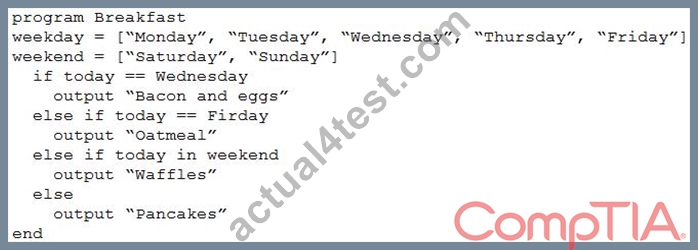
If the Breakfast program ran on Sunday, which of the following would be the output?
- A. Waffles
- B. Bacon and eggs
- C. Oatmeal
- D. Pancakes
Answer: A
NEW QUESTION # 126
A developer is creating specific step-by-step instructions/procedures and conditional statements that will be used by a computer program to solve problems. Which of the following is being developed?
- A. Pseudocode
- B. Flowchart
- C. Software
- D. Algorithm
Answer: D
Explanation:
Explanation
An algorithm is a set of specific step-by-step instructions/procedures and conditional statements that will be used by a computer program to solve problems. An algorithm defines the logic and sequence of actions that a computer program must follow to perform a task or achieve a goal. An algorithm can be expressed in various ways, such as pseudocode, flowchart, or natural language. References : The Official CompTIA IT Fundamentals (ITF+) Study Guide (FC0-U61), page 131.
NEW QUESTION # 127
......
CompTIA IT Fundamentals Certification exam helps to evaluate the foundational knowledge of the candidates, which is required to work in the IT industry. FC0-U61 exam can be taken by anyone, especially those who are trying to get their foot in the door of the IT industry. FC0-U61 exam is widely recognized as an entry-level certification exam that helps individuals understand the core concepts and tools used in the IT field.
FC0-U61 [Jan-2024] Newly Released] Exam Questions For You To Pass: https://www.actual4test.com/FC0-U61_examcollection.html
FC0-U61 Answers FC0-U61 Free Demo Are Based On The Real Exam: https://drive.google.com/open?id=1ikXCAHUW4rTcJ4iOPGlfaEeiQmbBiLS9