


Pass Your Next CTAL-TM-001 Certification Exam Easily & Hassle Free
Free ISTQB CTAL-TM-001 Exam Question Practice Exams
NEW QUESTION # 80
Your test team is in the process of completing final regression testing one week before the release date. One of your staff has just uncovered a critical defect that causes data corruption.
What should you do? [2]
- A. Update the risks in your test plan to cover data corruption issues and update your test cases to be sure you test for this in the future
- B. Write a high priority defect and follow the escalation communication plan as defined in your test plan
- C. Write a high priority defect and call the business stakeholders to warn them about it
- D. Update the weekly status charts and change the project status to red
Answer: B
Explanation:
The best action that you should take in this situation is to write a high priority defect and follow the escalation communication plan as defined in your test plan. This is because a critical defect that causes data corruption is a serious issue that can affect the quality, functionality, and reliability of the system, and it needs to be reported and resolved as soon as possible. By writing a high priority defect, you can document the details and the impact of the defect, and alert the development team and the project manager about it. By following the escalation communication plan, you can ensure that the defect is communicated to the appropriate stakeholders, such as the business sponsors, the customers, or the senior management, in a timely and effective manner, and that the necessary actions are taken to address the defect. Defect Reporting - ISTQB not-for-profit association References: Certified Tester Advanced Level Test Manager (CTAL-TM) - ISTQB not-for-profit association, ISTQB Test Manager Certification - ISTQB Exams Worldwide - ISTQB Official Registration, Defect Reporting - ISTQB not-for-profit association
NEW QUESTION # 81
Which of the following software characteristics are possibly revealed through the application of a open source static analysis tool?
- A. Memory leaks
- B. Timing dependencies
- C. Coding standard violations
- D. Concurrency thresholds
Answer: C
Explanation:
A static analysis tool is a software tool that analyzes the source code of a program without executing it. It can detect various software characteristics, such as syntax errors, potential bugs, security vulnerabilities, code quality, and coding standard violations. Coding standard violations are deviations from the agreed or recommended rules and conventions for writing source code, such as naming, indentation, formatting, commenting, and complexity. A static analysis tool can check the source code against a predefined or customized coding standard and report any violations. Coding standard violations can affect the readability, maintainability, and portability of the code, and can also introduce defects or inconsistencies. List of tools for static code analysisTop 5 Open Source Source and Free Static Code Analysis Tools in 2020 References:
* List of tools for static code analysis - Wikipedia
* Top 5 Open Source Source and Free Static Code Analysis Tools in 2020 - GeeksforGeeks
NEW QUESTION # 82
SoftTech provides a core banking product to retail banks to enable their customers to process payments via the Internet and telephone banking and. as SoftTech's Test Manager, you are responsible for system testing and system integration testing of all SoftTech's products.
Your current project is to integrate SoftTech's core banking product with an existing bank's systems, which are maintained by experienced developers but poorly documented.
A specification for the 10 interfaces to the bank's existing systems has been produced by SoftTech's development team. There is an estimating matrix for system integration testing that allows 2 man days per interface for preparation, plus 2 man days per interface for test execution. The exit criteria for the completion of system integration testing has been agreed as:
1. No open Severity 1 defects
2 No more than 10 open severity 2 and/or 3 defects
3. All interfaces tested
4. Cost estimate must not be exceeded
System integration test execution is scheduled to last 5 weeks, with week 5 reserved for regression and bug fixing only.
At the end of week 3 the following test report has been produced (figures on a week by week basis, not cumulative):
(b). Open severity 2 and 3 defects
(c). Interface testing progress
(d). Development resource for debugging
(e). Available budget
SELECT ONE OPTION
- A. b and c.
- B. c and d.
- C. c and e
- D. d and e.
Answer: B
NEW QUESTION # 83
You are the Test Manager of a risk-based testing effort. You develop the following graph to show residual risk. Assume that "Risks mitigated" represents passed tests and "Risks not mitigated" represents failed tests and other discovered failures.
Which of the following answers best represents what the graph shows? [3]
- A. Project is ahead of schedule due to number of risks addressed
- B. Project is on schedule based on total number of test cases executed
- C. Project is at risk due to the number of failed tests
- D. Project is behind schedule based on bug fix rate
Answer: C
Explanation:
The graph indicates that a significant portion of risks, 29%, have not been mitigated, which suggests that these are either failed tests or other discovered failures. This level of unmitigated risk puts the project at risk, as it implies that there are still substantial issues that need to be addressed.
Reference:
The ISTQB Advanced Level Test Manager documents outline the importance of risk-based testing and the interpretation of residual risk graphs. These graphs are used to communicate the current status of risk mitigation efforts in the project, and a high percentage of unmitigated risks is a clear indicator of potential problems1.
NEW QUESTION # 84
Since the system is in the medical domain and therefore in the safety critical area, testing needs to be rigorous and evidence is required that the system has been adequately tested. Identify THREE measures that would typically be part of the test approach in this domain and which are not always applicable in other domains! 1 credit
- A. Test design techniques
- B. Failure Mode and Effect Analysis (FMEA) sessions
- C. High level of documentation
- D. Master test planning
- E. Traceability to requirements
- F. Reviews
- G. Non-functional testing
Answer: B,C,E
NEW QUESTION # 85
You have been asked to make a recommendation on deployment readiness on the software your team has been testing.You have the following metrics: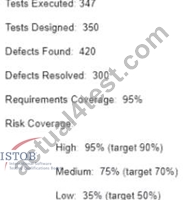
Given this information what is a critical metric you are missing?
- A. Residual risk
- B. Number of defects outstanding
- C. Number of tests passed
- D. Planned vs actual cost of testing
Answer: A
Explanation:
* Context Analysis:
* Deployment readiness depends on understanding the risk of releasing the software. The metrics provided include execution, design, defect counts, and coverage but do not quantifyresidual risk, which reflects remaining risks post-testing.
* Evaluation of Options:
* A. Number of tests passed:
* Incorrect. While important, it doesn't directly provide insight into the remaining risk.
* B. Number of defects outstanding:
* Incorrect. Though critical, it's only one aspect of assessing readiness and doesn't provide the full picture of residual risk.
* C. Residual risk:
* Correct. Residual risk quantifies untested areas and unresolved issues, vital for decision- making.
* D. Planned vs actual cost of testing:
* Incorrect. While useful for process evaluation, it's not directly tied to deployment readiness.
* Syllabus Alignment:
* The syllabus emphasizes risk-based approaches, highlighting residual risk as a critical deployment readiness metric (TM-1.3.4).
References:
ISTQB Advanced Level Test Management Syllabus (TM-1.3.4)
NEW QUESTION # 86
What occurs In the retrospective closing?
- A. A brainstorming session is held to discuss the solutions to the root causes of the most significant issues
- B. Everyone shakes hands
- C. The strengths and opportunities for improvement in the retrospectives are discussed
- D. The data collection methods are reviewed
Answer: C
Explanation:
Purpose of Retrospectives:
Retrospectives are team meetings aimed at reflecting on the work process to identify what went well (strengths) and areas that can be improved (opportunities).
This aligns with continuous process improvement practices.
Evaluation of Options:
A (Everyone shakes hands) is trivial and not a core activity.
B (Reviewing data collection methods) may be part of broader discussions but is not the primary focus.
C is correct because it directly reflects retrospective goals.
D (Brainstorming solutions) typically occurs in follow-up sessions, not during the retrospective itself.
Reference and Syllabus Alignment:
Retrospective practices are emphasized in "Improving the Test Process" (TM-1.5.4) in the syllabus.
NEW QUESTION # 87
Which statement about defect management in Agile software development is TRUE?
- A. Defect reports should be raised whenever actual results of a test do not match expected ones
- B. Defect reports are not required for defects that must be solved by a supplier
- C. Defect reports are not always necessary, but in some circumstances, they are needed
- D. Defect reports are unnecessary because of the high level of collaboration within the team
Answer: C
Explanation:
In Agile, defects discovered within the same sprint may be fixed without formal reports, but:
"Defect reports are typically required for defects that cannot be fixed immediately, require additional discussion, or involve external parties."
-ISTQB CTFL Syllabus 2018, Section 3.2.4
Thus,Option Ais the accurate and practical reflection of Agile defect handling.
NEW QUESTION # 88
At what testing level do the test management activities Include coordinating with end users7
- A. Acceptance testing
- B. Component Integration testing
- C. System testing
- D. Component testing
Answer: A
Explanation:
* End User Involvement in Testing Levels:
* Acceptance testing involves validating the product with the end users to ensure it meets their needs and requirements.
* It typically requires close coordination with end users for User Acceptance Testing (UAT).
* Evaluation of Options:
* A (Component testing)andB (Component Integration testing)do not involve end users, as these are technical-level testing activities.
* C (System testing)focuses on the integrated system but does not require end-user participation.
* Dis correct because acceptance testing involves direct collaboration with end users.
References and Syllabus Alignment:
* Covered under "Test Levels and Objectives" in the ISTQB syllabus (TM-1.2.5).
NEW QUESTION # 89
Consider the following metrics:
a Percentage of all product risks identified during initial risk analysis b. Average time taken by developers to fix defects for each severity level c. Statement coverage achieved by the component test suite d. Breakdown of defects detected by test level How many of the five primary dimensions for test progress monitoring have been addressed by these metrics?
SELECT ONE OPTION
- A. 0
- B. 1
- C. 2
- D. 3
Answer: B
NEW QUESTION # 90
Your last project was released three months ago and used a risk-based approach. In production, a number of serious failures in low risk areas have occurred.
What is the most important lesson to be learned from this information? [2]
- A. The project manager should have set stakeholder expectations for serious failures.
- B. Future projects should test the lower risk areas first.
- C. A broader cross-functional team should contribute to the risk analysis.
- D. The "lessons learned" session should have been conducted prior to deployment.
Answer: C
Explanation:
The most important lesson to be learned from this information is that a broader cross-functional team should contribute to the risk analysis. This is because the risk analysis is the process of identifying, assessing, and prioritizing the risks that may affect the quality of the system, and allocating testing resources accordingly. A broader cross-functional team can provide different perspectives, expertise, and experience to the risk analysis, and help to identify and evaluate the risks more accurately and comprehensively. This can reduce the likelihood of overlooking or underestimating some risks, and improve the effectiveness and efficiency of the risk-based testing approach. Risk Analysis - ISTQB not-for-profit association Reference: Certified Tester Advanced Level Test Manager (CTAL-TM) - ISTQB not-for-profit association, ISTQB Test Manager Certification - ISTQB Exams Worldwide - ISTQB Official Registration, Risk Analysis - ISTQB not-for-profit association
NEW QUESTION # 91
Which of the following phases in the fundamental test process is considered to deliver a document which can be used as a major input for test process improvement? 1 credit
- A. Evaluating exit criteria and reporting
- B. Test planning and control
- C. Test implementation & execution
- D. Test project closure
Answer: D
Explanation:
Topic 9, Scenario 9 "Test Management Documentation"
A software house is concerned about the number of defects found in software released to its customers. They are starting to plan a new software product. In the past, releases have often been stopped due to poor planning and too many defects found during high level testing. You have been recruited to the newly created position of test manager and asked to develop a test strategy, manage the testing of the project and organize the resources needed to carry out the testing.
NEW QUESTION # 92
You are working for an outsource testing company You have a client that will only consider candidates that are highly skilled with Salesforce. regardless of the number of years they have spent testing similar products You have looked through your skills matrix and you have no one with the right type of experience for this project.
What competence area is your team lacking?
- A. Social competence because they are lacking the ability to work with the rest of the team
- B. Methodical competence because they lack the ability to create test cases from a Salesforce requirements document
- C. Personal competence because they are not confident enough to pass the interviews with the client and they are not willing to learn Salesforce
- D. Professional competence because they do not have the required domain knowledge in Salesforce
Answer: D
Explanation:
Competence Analysis:
Professional competence refers to the knowledge and skills related to the specific domain, in this case, Salesforce.
The client's requirement emphasizes expertise in Salesforce, which your team lacks.
Evaluation of Options:
A (Social competence) and B (Personal competence) focus on interpersonal skills and attitude, not domain knowledge.
C (Methodical competence) involves creating test cases, which is unrelated to the issue described.
D is correct as the team lacks the required Salesforce-specific professional competence.
Reference and Syllabus Alignment:
Professional competence is highlighted under "Test Team Competencies" (TM-3.1.1).
NEW QUESTION # 93
Select THREE issues from the options provided that should at least be raised. 1 credit
- A. Has there been sufficient comparison of tools?
- B. How will the change process be managed?
- C. Is customized training available?
- D. How will the implementation be organized?
- E. What are the problems we are trying to address?
- F. Which project will be selected to perform the tool pilot?
- G. Do we have a set of tool requirements to validate the tool against?
Answer: A,E,G
NEW QUESTION # 94
When, at a minimum, should project risks be re-evaluated? [1]
- A. At the beginning of the test execution phase
- B. Prior to test case creation
- C. At major project milestones
- D. During the creation of the test plan
Answer: C
NEW QUESTION # 95
......
Ace CTAL-TM-001 Certification with 232 Actual Questions: https://www.actual4test.com/CTAL-TM-001_examcollection.html
PASS ISTQB CTAL-TM-001 EXAM WITH UPDATED DUMPS: https://drive.google.com/open?id=1s7X77lorVW41XPrinj6p554NeJFSU70X