


Microsoft DP-201 Practice Verified Answers - Pass Your Exams For Sure! [2021]
Valid Way To Pass Azure Data Engineer Associate's DP-201 Exam
NEW QUESTION 97
Inventory levels must be calculated by subtracting the current day's sales from the previous day's final inventory.
Which two options provide Litware with the ability to quickly calculate the current inventory levels by store and product? Each correct answer presents a complete solution.
NOTE: Each correct selection is worth one point.
- A. Consume the output of the event hub by using Azure Stream Analytics and aggregate the data by store and product. Output the resulting data into Databricks. Calculate the inventory levels in Databricks and output the data to Azure Blob storage.
- B. Output Event Hubs Avro files to Azure Blob storage. Use Transact-SQL to calculate the inventory levels by using PolyBase in Azure SQL Data Warehouse.
- C. Output Event Hubs Avro files to Azure Blob storage. Trigger an Azure Data Factory copy activity to run every 10 minutes to load the data into Azure SQL Data Warehouse. Use Transact-SQL to aggregate the data by store and product.
- D. Consume the output of the event hub by using Azure Stream Analytics and aggregate the data by store and product. Output the resulting data directly to Azure SQL Data Warehouse. Use Transact-SQL to calculate the inventory levels.
- E. Consume the output of the event hub by using Databricks. Use Databricks to calculate the inventory levels and output the data to Azure SQL Data Warehouse.
Answer: C,D
Explanation:
A: Azure Stream Analytics is a fully managed service providing low-latency, highly available, scalable complex event processing over streaming data in the cloud. You can use your Azure SQL Data Warehouse database as an output sink for your Stream Analytics jobs.
E: Event Hubs Capture is the easiest way to get data into Azure. Using Azure Data Lake, Azure Data Factory, and Azure HDInsight, you can perform batch processing and other analytics using familiar tools and platforms of your choosing, at any scale you need.
Note: Event Hubs Capture creates files in Avro format.
Captured data is written in Apache Avro format: a compact, fast, binary format that provides rich data structures with inline schema. This format is widely used in the Hadoop ecosystem, Stream Analytics, and Azure Data Factory.
Scenario: The application development team will create an Azure event hub to receive real-time sales data, including store number, date, time, product ID, customer loyalty number, price, and discount amount, from the point of sale (POS) system and output the data to data storage in Azure.
Reference:
https://docs.microsoft.com/bs-latn-ba/azure/sql-data-warehouse/sql-data-warehouse-integrate-azure-stream-analytics
https://docs.microsoft.com/en-us/azure/event-hubs/event-hubs-capture-overview
NEW QUESTION 98
You need to ensure that performance requirements for Backtrack reports are met.
What should you recommend? To answer, drag the appropriate technologies to the correct locations. Each technology may be used once, more than once, or not at all. You may need to drag the split bar between panes or scroll to view content.
NOTE: Each correct selection is worth one point.
Answer:
Explanation:
Explanation
Box 1: Cosmos DB indexes
The report for Backtrack must execute as quickly as possible.
You can override the default indexing policy on an Azure Cosmos container, this could be useful if you want to tune the indexing precision to improve the query performance or to reduce the consumed storage.
Box 2: Cosmos DB TTL
This solution reports on all data related to a specific vehicle license plate. The report must use data from the SensorData collection. Users must be able to filter vehicle data in the following ways:
* vehicles on a specific road
* vehicles driving above the speed limit
Note: With Time to Live or TTL, Azure Cosmos DB provides the ability to delete items automatically from a container after a certain time period. By default, you can set time to live at the container level and override the value on a per-item basis. After you set the TTL at a container or at an item level, Azure Cosmos DB will automatically remove these items after the time period, since the time they were last modified.
NEW QUESTION 99
Note: This question is part of a series of questions that present the same scenario. Each question in the series contains a unique solution that might meet the stated goals. Some question sets might have more than one correct solution, while others might not have a correct solution.
After you answer a question in this section, you will NOT be able to return to it. As a result, these questions will not appear in the review screen.
You have streaming data that is received by Azure Event Hubs and stored in Azure Blob storage. The data contains social media posts that relate to a keyword of Contoso.
You need to count how many times the Contoso keyword and a keyword of Litware appear in the same post every 30 seconds. The data must be available to Microsoft Power BI in near real-time.
Solution: You create an Azure Stream Analytics job that uses an input from Event Hubs to count the posts that have the specified keywords, and then send the data to an Azure SQL database. You consume the data in Power BI by using DirectQuery mode.
Does the solution meet the goal?
- A. No
- B. Yes
Answer: B
Explanation:
Explanation/Reference:
https://docs.microsoft.com/en-us/power-bi/service-real-time-streaming
https://docs.microsoft.com/en-us/azure/stream-analytics/stream-analytics-twitter-sentiment-analysis-trends
NEW QUESTION 100
You need to design the authentication and authorization methods for sensors.
What should you recommend? To answer, select the appropriate options in the answer area.
NOTE: Each correct selection is worth one point.
Answer:
Explanation:
Explanation
Sensor data must be stored in a Cosmos DB named treydata in a collection named SensorData Sensors must have permission only to add items to the SensorData collection Box 1: Resource Token Resource tokens provide access to the application resources within a Cosmos DB database.
Enable clients to read, write, and delete resources in the Cosmos DB account according to the permissions they've been granted.
Box 2: Cosmos DB user
You can use a resource token (by creating Cosmos DB users and permissions) when you want to provide access to resources in your Cosmos DB account to a client that cannot be trusted with the master key.
References:
https://docs.microsoft.com/en-us/azure/cosmos-db/secure-access-to-data
NEW QUESTION 101
You plan to use an Azure SQL data warehouse to store the customer dat
a. You need to recommend a disaster recovery solution for the data warehouse. What should you include in the recommendation?
- A. Geo-Redundant backups
- B. AzCopy
- C. AdICopy
- D. Read-only replicas
Answer: A
Explanation:
References:
https://docs.microsoft.com/en-us/azure/sql-data-warehouse/backup-and-restore
Topic 3, This is a case study. Case studies are not timed separately. You can use as much exam time as you would like to complete each case. However, there may be additional case studies and sections on this exam. You must manage your time to ensure that you are able to complete all questions included on this exam in the time provided.
Current environment
The company has the following virtual machines (VMs):
Requirements
Storage and processing
You must be able to use a file system view of data stored in a blob.
You must build an architecture that will allow Contoso to use the DB FS filesystem layer over a blob store. The architecture will need to support data files, libraries, and images. Additionally, it must provide a web-based interface to documents that contain runnable command, visualizations, and narrative text such as a notebook.
CONT_SQL3 requires an initial scale of 35000 IOPS.
CONT_SQL1 and CONT_SQL2 must use the vCore model and should include replicas. The solution must support 8000 IOPS.
The storage should be configured to optimized storage for database OLTP workloads.
Migration
You must be able to independently scale compute and storage resources.
You must migrate all SQL Server workloads to Azure. You must identify related machines in the on-premises environment, get disk size data usage information.
Data from SQL Server must include zone redundant storage.
You need to ensure that app components can reside on-premises while interacting with components that run in the Azure public cloud.
SAP data must remain on-premises.
The Azure Site Recovery (ASR) results should contain per-machine data.
Business Requirements
You must design a regional disaster recovery topology.
The database backups have regulatory purposes and must be retained for seven years.
CONT_SQL1 stores customers sales data that requires ETL operations for data analysis. A solution is required that reads data from SQL, performs ETL, and outputs to Power BI. The solution should use managed clusters to minimize costs. To optimize logistics, Contoso needs to analyze customer sales data to see if certain products are tied to specific times in the year.
The analytics solution for customer sales data must be available during a regional outage.
Security and auditing
Contoso requires all corporate computers to enable Windows Firewall.
Azure servers should be able to ping other Contoso Azure servers.
Employee PII must be encrypted in memory, in motion, and at rest. Any data encrypted by SQL Server must support equality searches, grouping, indexing, and joining on the encrypted data.
Keys must be secured by using hardware security modules (HSMs).
CONT_SQL3 must not communicate over the default ports
Cost
All solutions must minimize cost and resources.
The organization does not want any unexpected charges.
The data engineers must set the SQL Data Warehouse compute resources to consume 300 DWUs.
CONT_SQL2 is not fully utilized during non-peak hours. You must minimize resource costs for during non-peak hours.
NEW QUESTION 102
A company stores large datasets in Azure, including sales transactions and customer account information.
You must design a solution to analyze the data. You plan to create the following HDInsight clusters:
You need to ensure that the clusters support the query requirements.
Which cluster types should you recommend? To answer, select the appropriate configuration in the answer area.
NOTE: Each correct selection is worth one point.
Answer:
Explanation:
Explanation
Box 1: Interactive Query
Choose Interactive Query cluster type to optimize for ad hoc, interactive queries.
Box 2: Hadoop
Choose Apache Hadoop cluster type to optimize for Hive queries used as a batch process.
Note: In Azure HDInsight, there are several cluster types and technologies that can run Apache Hive queries.
When you create your HDInsight cluster, choose the appropriate cluster type to help optimize performance for your workload needs.
For example, choose Interactive Query cluster type to optimize for ad hoc, interactive queries. Choose Apache Hadoop cluster type to optimize for Hive queries used as a batch process. Spark and HBase cluster types can also run Hive queries.
References:
https://docs.microsoft.com/bs-latn-ba/azure/hdinsight/hdinsight-hadoop-optimize-hive-query?toc=%2Fko-kr%2F
NEW QUESTION 103
You plan to create a real-time monitoring app that alerts users when a device travels more than 200 meters away from a designated location.
You need to design an Azure Stream Analytics job to process the data for the planned app. The solution must minimize the amount of code developed and the number of technologies used.
What should you include in the Stream Analytics job? To answer, select the appropriate options in the answer area.
NOTE: Each correct selection is worth one point.
Answer:
Explanation:
Explanation
Input type: Stream
You can process real-time IoT data streams with Azure Stream Analytics.
Input source: Azure IoT Hub
In a real-world scenario, you could have hundreds of these sensors generating events as a stream. Ideally, a gateway device would run code to push these events to Azure Event Hubs or Azure IoT Hubs.
Function: Geospatial
With built-in geospatial functions, you can use Azure Stream Analytics to build applications for scenarios such as fleet management, ride sharing, connected cars, and asset tracking.
Reference:
https://docs.microsoft.com/en-us/azure/stream-analytics/stream-analytics-get-started-with-azure-stream-analytics
https://docs.microsoft.com/en-us/azure/stream-analytics/geospatial-scenarios
NEW QUESTION 104
You are designing a streaming solution that must meet the following requirements:
Accept input data from an Azure IoT hub.
Write aggregated data to Azure Cosmos DB.
Calculate minimum, maximum, and average sensor readings every five minutes.
Define calculations by using a SQL query.
Deploy to multiple environments by using Azure Resource Manager templates.
What should you include in the solution?
- A. Azure HDInsight with Spark Streaming
- B. Azure Functions
- C. Azure Stream Analytics
- D. Azure Databricks
Answer: D
Explanation:
Cosmos DB is ideally suited for IoT solutions. Cosmos DB can ingest device telemetry data at high rates.
Architecture
Data flow
Events generated from IoT devices are sent to the analyze and transform layer through Azure IoT Hub as a stream of messages. Azure IoT Hub stores streams of data in partitions for a configurable amount of time.
Azure Databricks, running Apache Spark Streaming, picks up the messages in real time from IoT Hub, processes the data based on the business logic and sends the data to Serving layer for storage. Spark Streaming can provide real time analytics such as calculating moving averages, min and max values over time periods.
Device messages are stored in Cosmos DB as JSON documents.
Reference:
https://docs.microsoft.com/en-us/azure/architecture/solution-ideas/articles/iot-using-cosmos-db
NEW QUESTION 105
You need to recommend the appropriate storage and processing solution?
What should you recommend?
- A. Enable auto-shrink on the database.
- B. Flush the blob cache using Windows PowerShell.
- C. Enable Apache Spark RDD (RDD) caching.
- D. Enable Databricks IO (DBIO) caching.
- E. Configure the reading speed using Azure Data Studio.
Answer: C
Explanation:
Explanation
Scenario: You must be able to use a file system view of data stored in a blob. You must build an architecture that will allow Contoso to use the DB FS filesystem layer over a blob store.
Databricks File System (DBFS) is a distributed file system installed on Azure Databricks clusters. Files in DBFS persist to Azure Blob storage, so you won't lose data even after you terminate a cluster.
The Databricks Delta cache, previously named Databricks IO (DBIO) caching, accelerates data reads by creating copies of remote files in nodes' local storage using a fast intermediate data format. The data is cached automatically whenever a file has to be fetched from a remote location. Successive reads of the same data are then performed locally, which results in significantly improved reading speed.
References:
https://docs.databricks.com/delta/delta-cache.html#delta-cache
NEW QUESTION 106
You are planning a design pattern based on the Lambda architecture as shown in the exhibit.
Which Azure services should you use f2 or the cold path? To answer, drag the appropriate services to the correct layers. Each service may be used once, more than once, or not at all. You may need to drag the split bar between panes or scroll to view content.
NOTE: Each correct selection is worth one point.
Answer:
Explanation: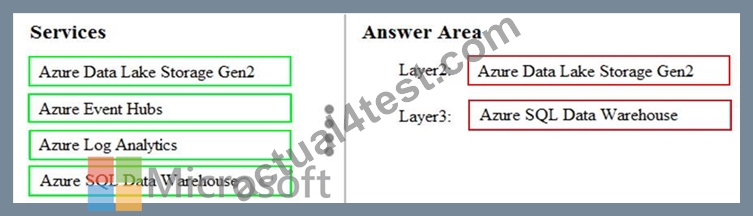
Explanation:
Layer 2: Azure Data Lake Storage Gen2
Layer 3: Azure SQL Data Warehouse
Azure SQL Data Warehouse can be used for batch processing.
Note: Lambda architectures use batch-processing, stream-processing, and a serving layer to minimize the latency involved in querying big data.
References:
https://azure.microsoft.com/en-us/blog/lambda-architecture-using-azure-cosmosdb-faster-performance-low-tco-low-devops/
https://docs.microsoft.com/en-us/azure/architecture/data-guide/technology-choices/batch-processing
NEW QUESTION 107
You use Azure Data Lake Storage Gen2 to store data that data scientists and data engineers will query by using Azure Databricks interactive notebooks. The folders in Data Lake Storage will be secured, and users will have access only to the folders that relate to the projects on which they work.
You need to recommend which authentication methods to use for Databricks and Data Lake Storage to provide the users with the appropriate access. The solution must minimize administrative effort and development effort Which authentication method should you recommend for each Azure service? To answer, select the appropriate options in the answer area NOTE: Each correct selection is worth one point.
Answer:
Explanation:
Explanation
Databricks: Personal access tokens
To authenticate and access Databricks REST APIs, you use personal access tokens. Tokens are similar to passwords; you should treat them with care. Tokens expire and can be revoked.
Data Lake Storage: Azure Active Directory
Azure Data Lake Storage Gen1 uses Azure Active Directory for authentication.
References:
https://docs.azuredatabricks.net/dev-tools/api/latest/authentication.html
https://docs.microsoft.com/en-us/azure/data-lake-store/data-lakes-store-authentication-using-azure-active-directo
NEW QUESTION 108
You have an on-premises data warehouse that includes the following fact tables. Both tables have the following columns: DataKey, ProductKey, RegionKey. There are 120 unique product keys and 65 unique region keys.
Queries that use the data warehouse take a long time to complete.
You plan to migrate the solution to use Azure SQL Data Warehouse. You need to ensure that the Azure-based solution optimizes query performance and minimizes processing skew.
What should you recommend? To answer, select the appropriate options in the answer area.
NOTE: Each correct selection is worth one point.
Answer:
Explanation:
Explanation
Box 1: Hash-distributed
Box 2: ProductKey
ProductKey is used extensively in joins.
Hash-distributed tables improve query performance on large fact tables.
Box 3: Round-robin
Box 4: RegionKey
Round-robin tables are useful for improving loading speed.
Consider using the round-robin distribution for your table in the following scenarios:
* When getting started as a simple starting point since it is the default
* If there is no obvious joining key
* If there is not good candidate column for hash distributing the table
* If the table does not share a common join key with other tables
* If the join is less significant than other joins in the query
* When the table is a temporary staging table
Note: A distributed table appears as a single table, but the rows are actually stored across 60 distributions. The rows are distributed with a hash or round-robin algorithm.
References:
https://docs.microsoft.com/en-us/azure/sql-data-warehouse/sql-data-warehouse-tables-distribute
NEW QUESTION 109
You need to design the storage for the visual monitoring system.
Which storage solution should you recommend?
- A. Azure SQL database
- B. Azure Media Services
- C. Azure Blob storage
- D. Azure Table storage
Answer: C
Explanation:
Explanation
Azure Blobs: A massively scalable object store for text and binary data.
Scenario:
* The visual monitoring system is a network of approximately 1,000 cameras placed near highways that capture images of vehicle traffic every 2 seconds. The cameras record high resolution images. Each image is approximately 3 MB in size.
* The solution must allow for searches of vehicle images by license plate to support law enforcement investigations. Searches must be able to be performed using a query language and must support fuzzy searches to compensate for license plate detection errors.
Reference:
https://docs.microsoft.com/en-us/azure/storage/common/storage-introduction
NEW QUESTION 110
A company is evaluating data storage solutions.
You need to recommend a data storage solution that meets the following requirements:
Minimize costs for storing blob objects.
Optimize access for data that is infrequently accessed.
Data must be stored for at least 30 days.
Data availability must be at least 99 percent.
What should you recommend?
- A. Premium
- B. Cold
- C. Archive
- D. Hot
Answer: B
Explanation:
Explanation
Azure's cool storage tier, also known as Azure cool Blob storage, is for infrequently-accessed data that needs to be stored for a minimum of 30 days. Typical use cases include backing up data before tiering to archival systems, legal data, media files, system audit information, datasets used for big data analysis and more.
The storage cost for this Azure cold storage tier is lower than that of hot storage tier. Since it is expected that the data stored in this tier will be accessed less frequently, the data access charges are high when compared to hot tier. There are no additional changes required in your applications as these tiers can be accessed using APIs in the same manner that you access Azure storage.
References:
https://cloud.netapp.com/blog/low-cost-storage-options-on-azure
NEW QUESTION 111
You are planning the deployment of two separate Azure Cosmos DB databases named db1 and db2.
You need to recommend a deployment strategy that meets the following requirements:
* Costs for both databases must be minimized.
* Db1 must meet an SLA of 99.99% for both reads and writes.
* Db2 must meet an SLA of 99.99% for writes and 99.999% for reads.
Which deployment strategy should you recommend for each database? To answer, select the appropriate options in the answer area.
NOTE: Each correct selection is worth one point.
Answer:
Explanation:
Explanation
Db1: A single read/write region
Db2: A single write region and multi read regions
References:
https://docs.microsoft.com/en-us/azure/cosmos-db/high-availability
NEW QUESTION 112
......
Microsoft DP-201 Pre-Exam Practice Tests | Actual4test: https://www.actual4test.com/DP-201_examcollection.html